
Recognising AuDHD Burnout as a Late-Diagnosed Senior Leader
From incompatibility to redesign: Why your burnout isn't your failure, but a systems mismatch.
You’re a senior leader. VP, director, executive. You’ve built a reputation on intensity, high performance, strategic clarity. You’ve done this for years, maybe decades.
And somewhere along the way, something stopped working.
You burned out mid-career while still leading. Rest didn’t help. Boundaries didn’t help. A reduced workload did nothing. You’re still depleted, still performing, still meeting expectations, while also processing a late diagnosis that suddenly explains far more than you expected.
Gradually, you realise: you’re not losing your job. You’re not failing as a leader. Your skills haven’t vanished. They’ve been running inside a system that was never designed for the way your brain actually works.
This piece is for you if:
You’re still leading while burned out
Standard burnout advice hasn’t touched your exhaustion
You were diagnosed (or self-recognised) because burnout forced the question
You’re worrying what this means for your capability
You can’t simply step away from the role
You’re grieving decades of compensating and wondering what sustainable leadership looks like now
Your Burnout Isn’t Weakness — It’s a Signal
Late-diagnosed neurodivergent burnout isn’t a failure of resilience. It’s a systems incompatibility.
You didn’t burn out because you weren’t disciplined enough or tough enough. You burned out because you were operating in an environment built for a different kind of brain. You survived it through extraordinary adaptation—until the compensations finally collapsed.
Research on neurodivergent burnout shows the same pattern: when the brain and the environment don’t match, the cognitive cost of adaptation accumulates invisibly (Czerw et al., 2021; Firth & Firth, 2021). Masking, translating, forcing executive function, performing socially: none of this is “just effort.” It’s labour.
What feels like failure is actually evidence of endurance.
You took an ADHD nervous system (fast-moving, crisis-capable, intensely creative) and an autistic nervous system (pattern-driven, detail-oriented, systematic) and you made them succeed, inside a structure that never matched them.
That wasn’t weakness. It was exceptional capacity.
And exceptional capacity spent on adaptation eventually runs out.
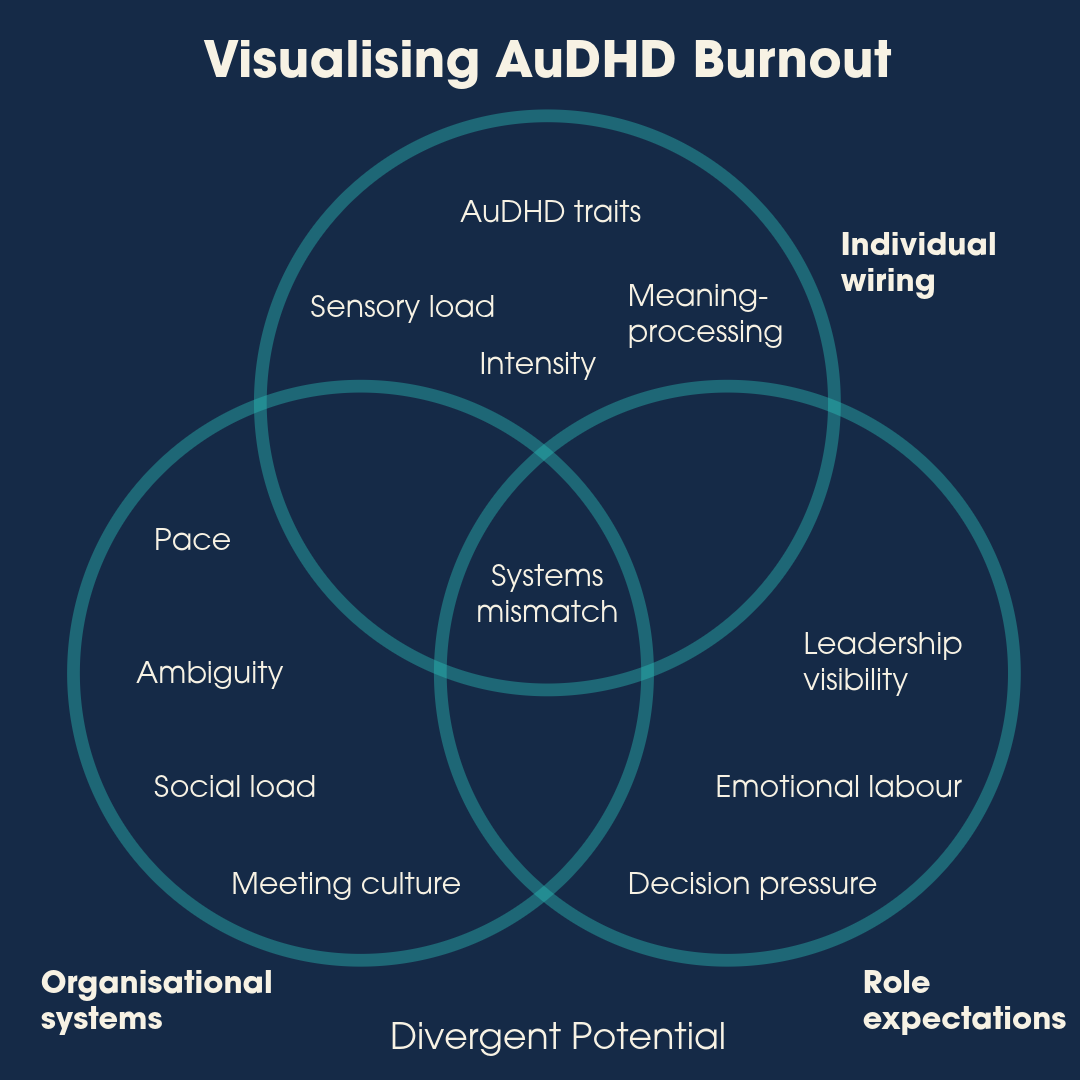
Why Rest Doesn’t Work: Two Nervous Systems, Opposing Needs
AuDHD burnout isn’t simple depletion. It’s the collision of two systems trying to recover in opposite directions.
Your ADHD nervous system is exhausted from:
chronic executive function strain
dopamine scarcity from forcing focus on non-preferred tasks
maintaining organisation that never sticks
It needs: stimulation, novelty, low friction, activation.
Your autistic nervous system is exhausted from:
sensory, social, and cognitive overload
masking done far beyond capacity
constant social decoding and environmental unpredictability
It needs: predictability, low demand, sensory rest, safety.
The lived conflict
You try to rest, your ADHD system panics at the stillness. You try to re-engage, your autistic system shuts down from the overload.
Both needs are real. Both are urgent. Both are incompatible in crisis.
This is not indecision or laziness. It’s internal neurological conflict, and neither side can win under the current conditions.
Late Diagnosis: When the Patterns Suddenly Make Sense
When you get diagnosed during burnout, the ground shifts.
The traits you once labelled as flaws—time blindness, difficulty with social nuance, inconsistent performance, intensity, “overthinking,” needing pressure to focus—suddenly become intelligible. They’re not failures. They’re features.
And the strengths were real, too:
exceptional pattern recognition
strategic thinking
hyperfocus
rapid crisis response
deep problem-solving
Burnout isn’t just exhaustion. It’s the moment your masking collapses and you finally see the decades-long cost of compensating.
You’re not only recovering from burnout—you’re processing:
the realisation you’ve been adapting, not thriving
grief for lost years and lost energy
fear about what comes next
a new question: What does leadership look like without masking?
Burnout didn’t break you. It revealed you.
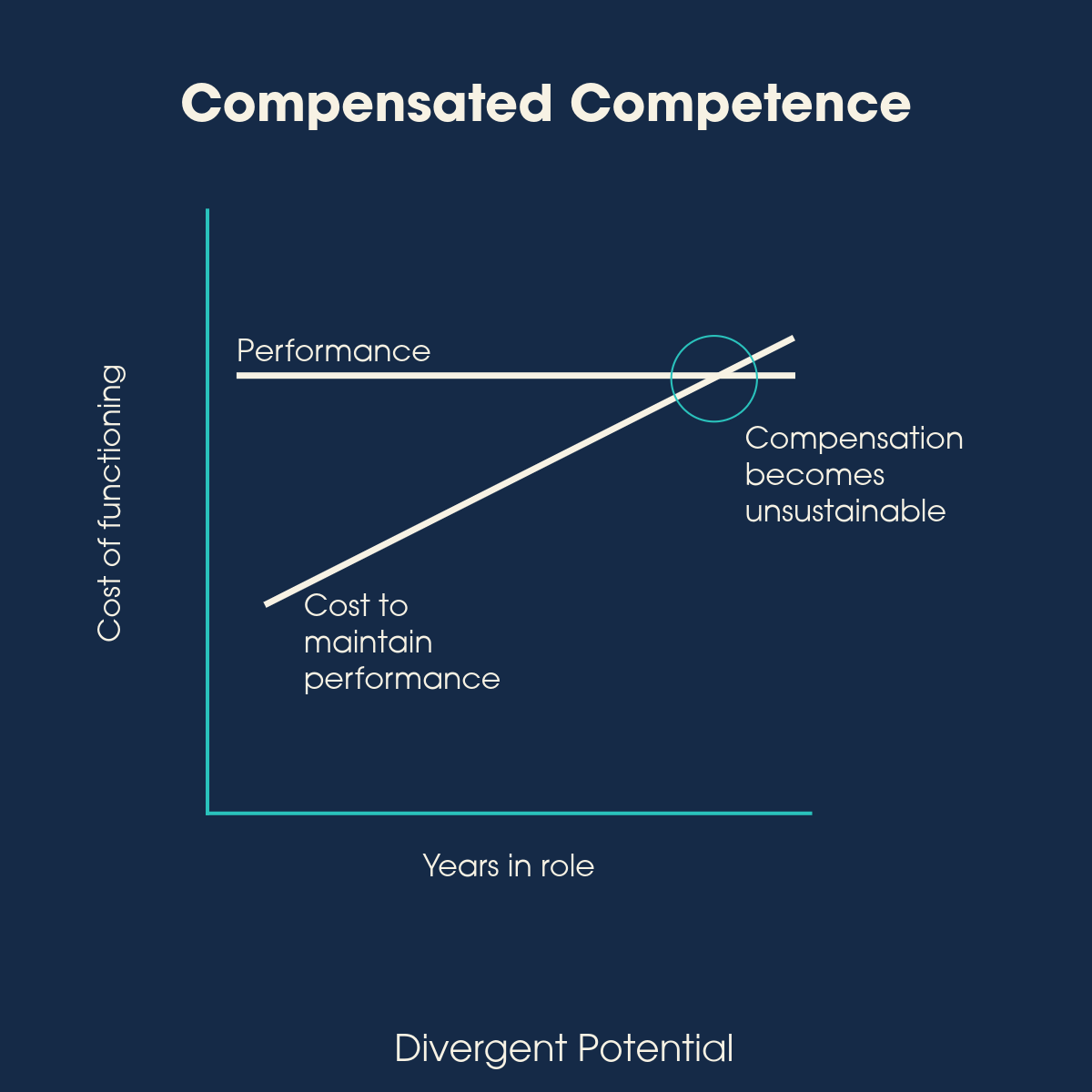
Why Standard Recovery Advice Doesn’t Work
Conventional burnout recovery assumes a neurotypical pattern: reduce workload → regain balance → return to baseline.
But when burnout stems from environmental incompatibility, not overwork, rest doesn’t fix the root cause.
Neurotypical Burnout
Cause: external overload
Fix: reduce load
Recovery: weeks to months
Neurodivergent Burnout
Cause: chronic adaptation in an incompatible system
Fix: environmental redesign
Recovery: months to years, nonlinear
This explains why:
Time off doesn’t restore you
Delegation doesn’t change how depleted you feel
Boundaries don’t reduce cognitive load
You’re not failing at recovery.
You’re recovering in the wrong paradigm.
Recovery Timelines: What Research Actually Shows
Recovery from AuDHD burnout often spans 6 months to several years (Firth & Firth, 2021). Not because you’re broken—because your system needs redesign, not rest.
It’s not linear. Some days require stimulation, others require sensory retreat. Often both in the same day.
It’s not predictable. Clarity comes in waves. Energy returns inconsistently. Capacity expands, contracts, expands again.
Relapse happens when you go back to the same system unchanged.
Not because you weren’t ready—but because the environment remained incompatible.
Once you redesign the system, relapse stops being inevitable.
What Actually Changes: Internal First, External Second
You can’t instantly restructure an organisation. But the first and most powerful shift isn’t external anyway—it’s how you interpret yourself.
Internal shifts that start recovery immediately:
Accepting burnout as incompatibility, not weakness
Reducing masking—without waiting for permission
Naming what you actually need
Reframing decreased masking as liberation, not loss
Redefining sustainable leadership on your terms
These internal shifts free the energy that was spent on performing. With that energy back, clarity increases. Then external redesign becomes possible.
External redesign—what the system must eventually adapt:
A role that no longer centralises you as the bottleneck
Fewer high-frequency meetings
Reduced context-shifting
Predictable sensory and cognitive demands
Clear delegation structures
Work aligned with your strengths instead of your compensations
External redesign doesn’t start with the organisation. It starts with your clarity about what no longer works.
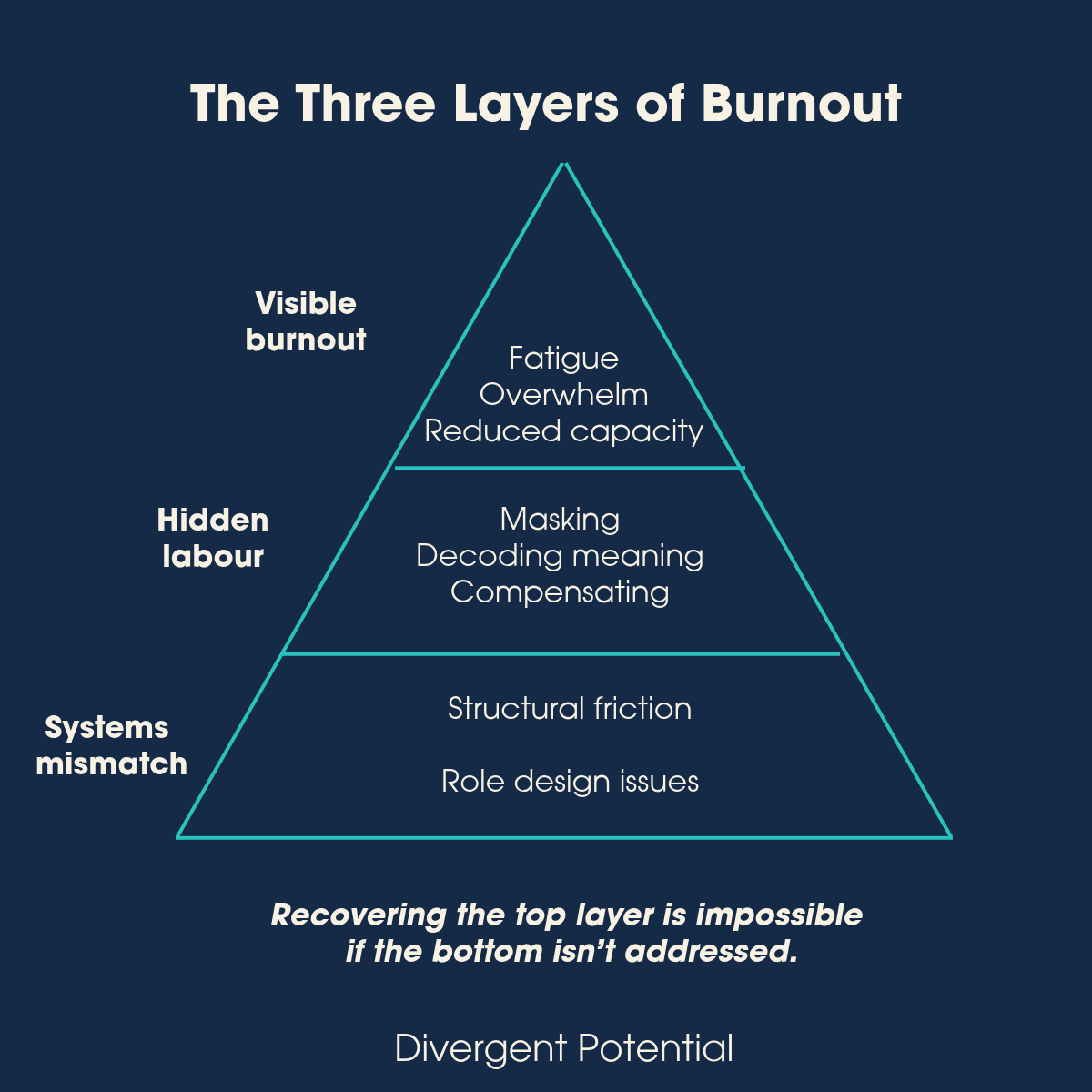
Shift 1: Stop Treating Burnout as Personal Failure
Burnout is a diagnostic signal.
It shows you where the environment and your neurology collide. Once the system changes, your capability returns—not because you “try harder,” but because you stop spending energy on survival.
Shift 2: Recognise What You’ve Actually Been Doing
Ask yourself honestly:
Does your role require constant intensity?
Do people rely on you as the decision bottleneck?
Do you spend more time translating than leading?
Do you mask in nearly every meeting?
If the answer is yes, burnout wasn’t caused by weakness—it was caused by misallocation of strengths.
Your executive function, strategic thinking, and pattern recognition weren’t failing. They were being consumed by adaptation.
When that energy is redirected into the actual work you’re brilliant at, everything changes.
Shift 3: Redesign Leadership for Your Brain
Your leadership model doesn’t need to mimic neurotypical norms. It needs to align with your neurology.
Effective redesign often includes:
Predictable cycles (e.g., seasons of depth, seasons of breadth)
Limited meeting load with protected focus time
Stimulating work with clear boundaries
Fewer “firefighting” demands
Communication formats that minimise social translation
Structures that support hyperfocus without letting it take over
One VP I worked with adopted seasonal leadership cycles:
Q1–Q2: deep strategic focus
Q3: transition/light load
Q4: broad leadership visibility
Her capacity increased. Her team stabilised. Burnout never returned.
Shift 4: Accept What Changes—And What Becomes Possible
Some things will not return to your pre-burnout baseline—and you don’t want them to.
You may never regain your old masking capacity. You may never tolerate the same sensory load. You may no longer be able to operate through relentless intensity.
This is not loss. It’s clarity.
The energy once spent on performance becomes available for:
better strategic thinking
more authentic relationships
better leadership presence
deeper creativity
actual wellbeing
Your capability doesn’t diminish. It is rerouted, helping you to become more effective with the energy you give to your work.
The Uncomfortable Part: Redefining Leadership Identity
Sustainable leadership might require changes that feel threatening to the identity you built—especially if that identity was forged in intensity.
It may require:
delegating decisions you once clung to
stepping back from over-visibility
embedding recovery cycles into your leadership model
rejecting “always on” as the mark of commitment
redefining success around clarity and sustainability
But when leaders do this work, they don’t lose impact—they multiply it.
When you lead while burned out, you operate at 60%.
When you lead sustainably, you operate fully.
Your team feels the difference. Retention increases. Creativity returns. Decision-making sharpens. Authenticity deepens.
You don’t lose your role. You reclaim it.
The Bottom Line: Your Burnout Showed You the Truth
If you recognise yourself in this—if you’re depleted, conflicted, capable but struggling—then this is the most important thing to understand:
You’re not failing at leadership.
You’re leading inside a model that wasn’t built for your neurology.
Burnout didn’t break you.
It revealed the mismatch.
Now that you understand the blueprint, you don’t need to “recover into” your old system. You can redesign the system around the way your brain actually works.
When you do:
Your capability doesn’t return—it redirects
Your leadership becomes sharper, clearer, more authentic
Your team thrives under the leadership you can actually sustain
You stay in your role, not by surviving it, but by reshaping it
Your nervous system isn’t the problem.
The model was incompatible.
Now that you see it, you can build one that fits.
This isn’t the end of your leadership.
It’s the beginning of sustainable leadership on your terms.
If you're burned out, newly diagnosed or self-recognising, still in a role, and wondering what sustainable actually looks like—the next step is clarity about what's actually happening in your specific situation.
That's where coaching comes in. We explore what's driving your burnout, what's actually incompatible in your current model, and what sustainable leadership looks like for your brain and your role.
Jason Bennett is a neurodivergent professional coach specialising in AuDHD and late diagnosis integration. He works with late-identified senior leaders navigating burnout recovery, identity integration, and the redesign of leadership that comes after diagnosis.
Most leaders who do this work don't leave their organisations. They redesign how they lead within them—and everything changes: their capacity, their team, their impact, their life.
If you recognise yourself here, let's explore what's actually possible.
References
Czerw, A., et al. (2021). Burnout among healthcare workers. International Journal of Environmental Research and Public Health, 18(16), 8529.
Firth, H., & Firth, N. (2021). Burnout and mental health issues in neurodivergent individuals. Neurodiversity and Mental Health, 5(2), 112-128.