
And Why It Never Shows in the Metrics
You’re delivering at a high level. But the cost isn’t in the metrics.
There is a version of senior leadership that looks, from the outside, like high performance.
The outputs are there. The delivery is consistent. The leader shows up, holds the room, makes the calls. Boards are reassured. Teams are managed. The machine keeps running.
What isn’t visible — and what rarely gets examined — is what sustaining that performance actually requires.
The energy it takes to walk into every room as the version of yourself the room expects. The preparation that happens before the meeting — not the strategic kind, but the regulatory kind: calculating how to calibrate presence, pace, and expression in real time. The version of yourself you maintain through three hours of back-to-back leadership, then quietly dismantle on the drive home.
And what’s left over — genuinely left over — for the thinking the role actually demands.
“That gap between visible output and invisible cost has a name. Some leaders have been carrying it for decades without one.”
The Metric That Doesn’t Appear in Any Report
Every senior leader pays a performance tax. Pressure, complexity, ambiguity — these all have costs, and those costs are a normal feature of operating at this level.
The question isn’t whether the tax exists. It’s whether what you’re paying is proportionate to what the role actually demands.
For a significant number of senior leaders — specifically those who are neurodivergent, identified late or not yet at all — it isn’t.
The difference isn’t capability. It isn’t resilience, or commitment, or suitability for the level. It’s that a meaningful portion of cognitive and emotional resource is going somewhere that standard frameworks don’t measure: the constant, low-level, largely automatic process of managing how you appear, how you communicate, and how you’re read — in environments that weren’t designed for how you’re actually wired.
Researchers and practitioners use the word masking for this. In senior professional environments, it rarely travels under that name. It travels as:
Executive presence
Professionalism
Resilience
The capacity to lead without making it look difficult
These aren’t wrong descriptions. But they’re incomplete ones. They describe the output without accounting for the mechanism producing it — and the mechanism has a cost that the output consistently conceals.
The data point: A 2025 Harris Poll found that 77% of all adults agree that neurodivergent employees face pressure to conform to neurotypical behaviours at work — rising to 82% among neurodivergent individuals themselves.
At senior level, that pressure doesn’t diminish with seniority. It compounds. The compensation strategies that carried these leaders to director, VP, and executive level were built for a different altitude. At this altitude, they start to cost more than they return.
What the Tax Is Actually Buying
It’s worth being precise here, because masking is frequently misconstrued as performance in the theatrical sense — something deliberate and consciously chosen. That’s rarely how it operates.
For most late-identified neurodivergent leaders, the compensation strategies are not performances. They’re deep, automatic, and sophisticated — built incrementally over a career spent learning, often without knowing it, how to operate in environments that weren’t designed for the way they think.
The strategies work. That’s the point. They got these leaders here.
But here is not where the strategies were designed for. The cost of running them at senior level — where every day involves more ambiguity, higher stakes, and fewer explicit rules — is different in kind from the cost of running them at earlier career stages.
I know this because I spent 25 years in technology leadership running exactly these strategies — without knowing that’s what they were. The VP-level version of me was highly effective and running at a cost I couldn’t account for and wouldn’t have been able to name. The late-diagnosis version understood, finally, where the bill was going. That gap between those two versions of the same career is where the real work begins.
In the framework I’ve developed specifically for AuDHD leaders — built from that experience and from coaching senior professionals navigating the same terrain — I describe it this way: the autistic nervous system pays the bill for what the ADHD brain ordered.The FRICTION framework starts here, because understanding the cost structure is the prerequisite for changing it.
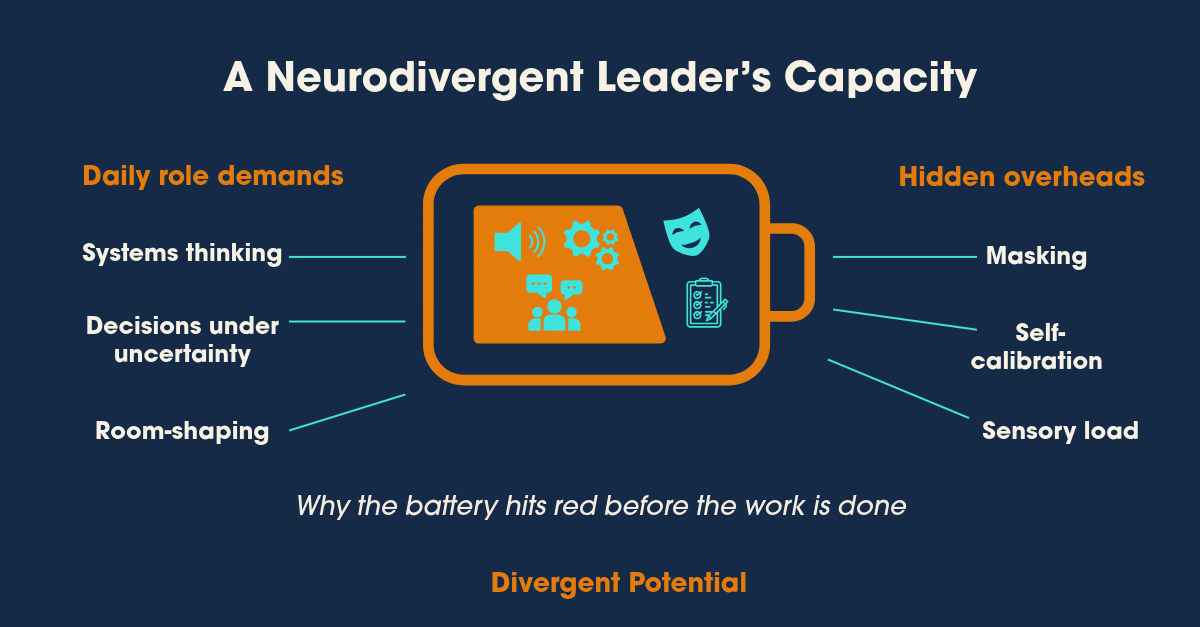
What a senior leadership day actually demands
Systemic thinking across multiple competing priorities
Holding genuine uncertainty without the relief of a correct answer
Reading rooms accurately while simultaneously shaping them
Making decisions in the presence of incomplete information
Being scrutinised while appearing unaffected by the scrutiny
Now layer on top of that the additional processing load of simultaneously managing how you’re being read. Monitoring communication style in real time. Suppressing responses that feel natural in order to produce ones that read as expected. Adjusting to sensory environments you can’t control. Navigating social dynamics through conscious analysis rather than intuitive ease.
The capacity being used for that second layer is not separate from the capacity being used for the first. It comes from the same pool. And it doesn’t appear on any dashboard.
What this means in practice: leaders carrying a disproportionate tax are making decisions, building relationships, and doing strategic thinking on a fraction of the cognitive bandwidth the role nominally assumes they have. The output often looks the same. The quality of the thinking underneath may not be.
Why the Cost Stays Hidden
The leaders least likely to flag this are the ones best at managing it.
High-functioning, high-achieving, highly self-aware — a senior leader who has spent decades developing effective strategies for navigating environments not designed for them doesn’t look like someone struggling. They look like someone exceptional. Which is often accurate. But it doesn’t mean the cost isn’t real.
Only 34% of neurodivergent employees report feeling well supported at work. At senior level, that gap rarely surfaces as a complaint or a request.
It surfaces as something else entirely:
The exits organisations describe as coming from nowhere
The sudden disengagement from leaders who had been delivering for years
The decisions to step back that seem disproportionate to what was visible from outside
These aren’t failures of resilience. They’re the natural endpoint of a system running too long at above-capacity cost.
The invisibility is structural. Standard performance conversations, wellbeing frameworks, and most coaching approaches were not designed to detect this. They measure output. They ask about goals, challenges, and development priorities. They do not ask: what is this performance actually costing you at the level below what you’re willing to name?
And most senior leaders — even with excellent self-awareness — don’t have reliable access to that answer. Because the strategies are so embedded and so automatic that the cost has simply become the texture of working life.
The Category Error That Keeps This Unaddressed
When the cost eventually becomes visible — through attrition signals, a shift in decision quality, burnout language, or the leader finally naming something — the response usually takes one of two forms:
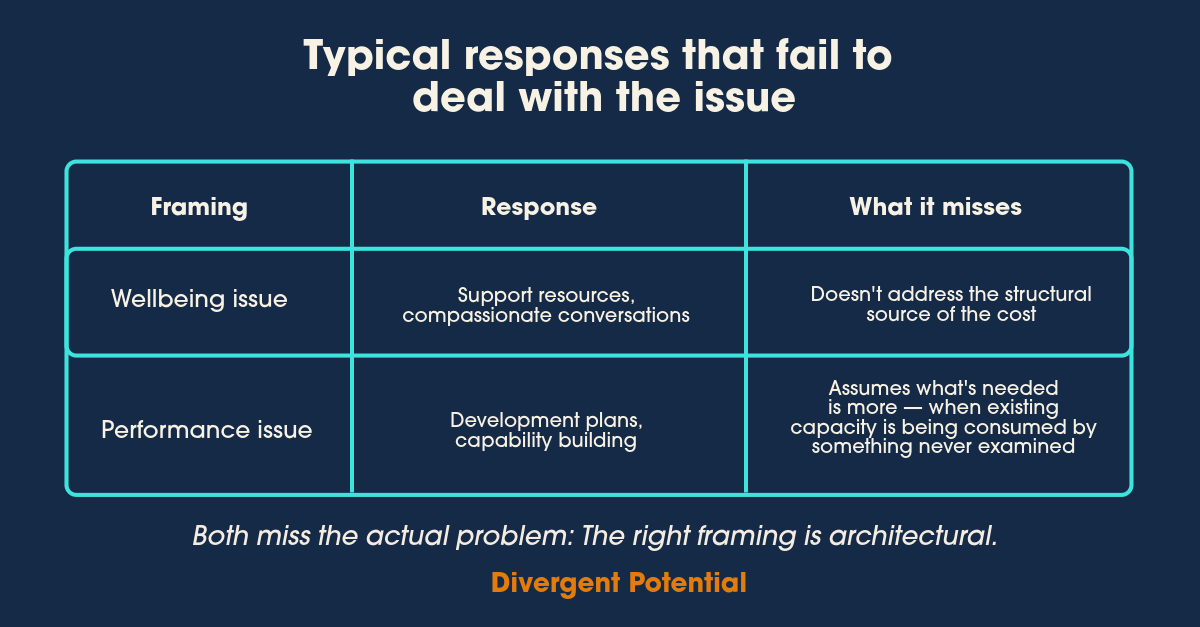
The question isn’t “how does this leader sustain better?” or “how does this leader perform better?” It’s: what is the actual cost structure of how this leader operates, where is that cost disproportionate relative to what the role demands, and what changes when the overhead is reduced?
That’s not a wellbeing question. It’s a leadership performance question. And it has practical, concrete answers.
What Reducing the Tax Actually Looks Like
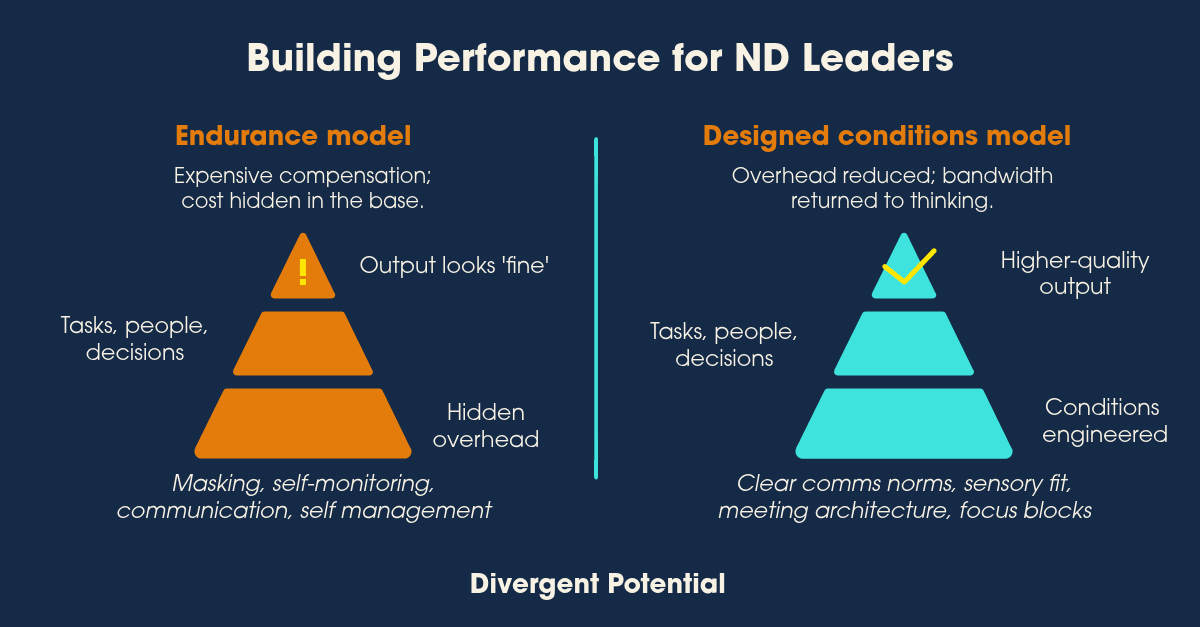
The work isn’t about removing challenge or designing a role around individual comfort. Senior leadership is inherently demanding. The point is precision — building performance on design rather than endurance.
For late-identified neurodivergent leaders, that typically involves three things that don’t happen in standard coaching:
1. Naming what’s actually happening — not the behaviour, the mechanism
Understanding specifically what is generating the disproportionate cost, rather than addressing its symptoms. This requires a coaching relationship with enough depth and neurological literacy to get below the surface-level narrative the leader has developed to explain their experience.
2. Separating genuine limitation from compensated strength
Many of the capabilities that look most like problems in senior environments — unconventional communication, non-linear thinking, intensity of processing — are, when properly understood and designed around, the same capabilities that produced the track record. The work is learning to distinguish between what needs designing around and what simply needs translating.
3. Building toward conditions rather than willpower
The endurance model is the default because it’s what got these leaders here. The alternative isn’t softness — it’s efficiency. Understanding the specific conditions under which a leader thinks, decides, and leads most effectively, and actively building more of them, is not accommodation. It’s engineering.
For organisations, the business case is direct: a senior leader operating closer to their actual cognitive bandwidth makes better decisions, exercises better judgment, and has more to give the leadership challenge the role actually demands. The tax reduction doesn’t just benefit the individual. It produces the output the organisation is currently paying for — and not fully receiving.
The Question Worth Asking
The leaders who benefit most from this kind of work tend to share a recognisable quality: they have long suspected there is a more efficient, more sustainable version of how they could be operating — but have had no proper framework or relationship in which to examine what that looks like.
They’ve often done coaching before. Found it useful. But something it didn’t quite reach. A layer of the work that kept being approached and never properly landing.
Looking back, the gap is usually clearer: the development addressed behaviour while leaving the architecture that drives it entirely unexamined.
Understanding the architecture is the work. Not as an intellectual exercise — as the foundation for building something more sustainable than what endurance alone can produce, and more effective than what a leader running on reduced bandwidth can consistently deliver.
What senior leadership performance looks like when it’s built on accurate design rather than expensive compensation — that’s the question worth asking. And it has a substantively different answer than the one most leadership development conversations are currently equipped to give.
For senior leaders
The work of examining your own cost structure is exactly what the Executive Coaching for Professionals engagement is designed for. It’s a rigorous, confidential thinking partnership — not a support programme. The leaders who get the most from it are those who have been performing well for years and are ready to stop leaving the better version of that performance on the table.
For HR and L&D decision-makers
The leaders described in this piece are almost certainly in your senior cohort. They’re not flagging it. The Coaching for Organisations page covers how this work is structured at scale — and why the ROI case is strongest precisely for the leaders you’d never think to refer.