
For senior leaders navigating late diagnosis — and the organisations that work with them
Most people hear AuDHD and think: two diagnoses, double the difficulty.
That's not the experience I hear from the senior professionals I work with. And it's not my own experience either.
What AuDHD describes is not an accumulation of deficits. It's two distinct neurotypes — autism and ADHD — running simultaneously, sometimes in harmony, sometimes in productive tension with each other. The result is an operating system that processes the world differently, responds to it differently, and leads within it differently.
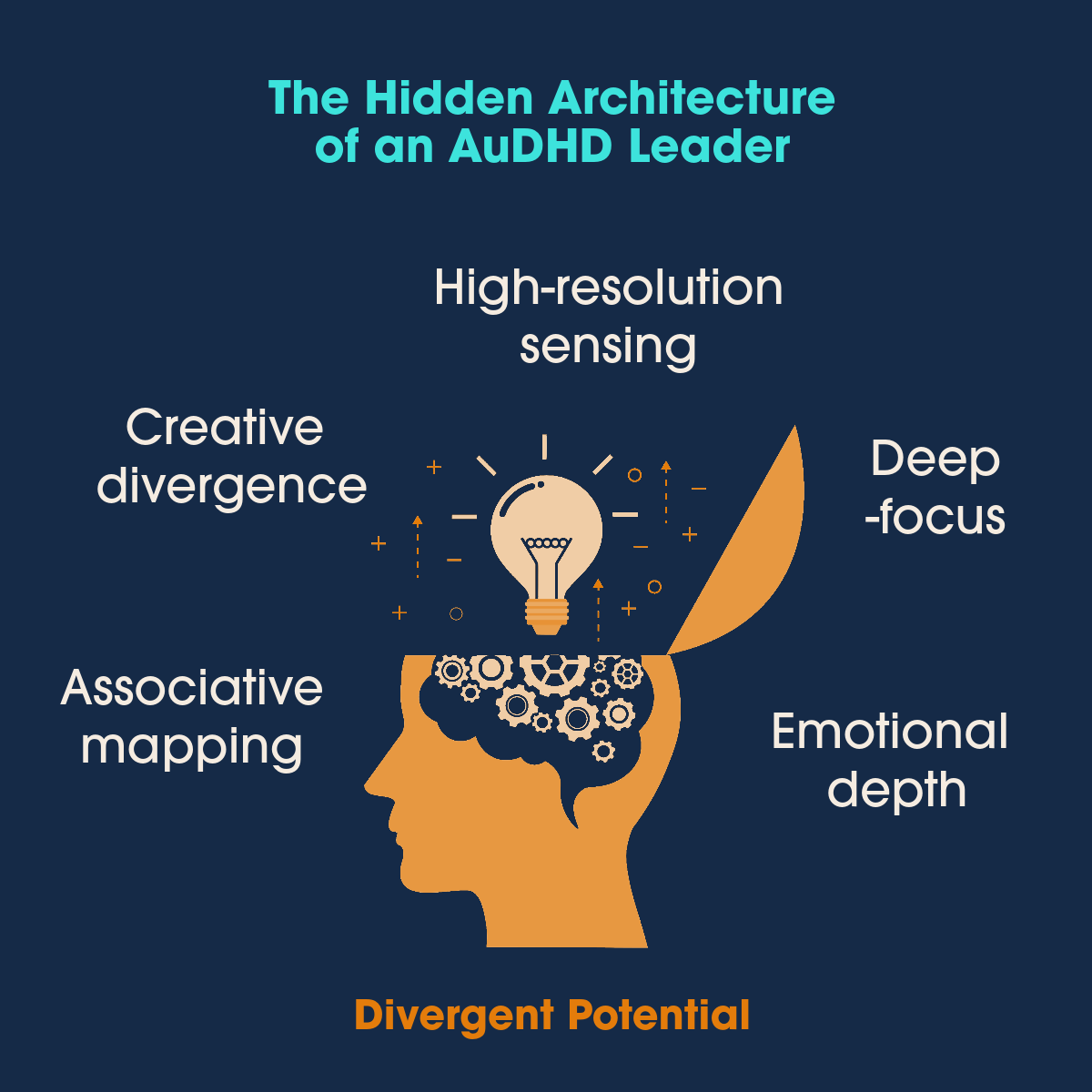
For many of the leaders I work with, the AuDHD diagnosis arrives late. Not in childhood, when accommodations might have been put in place, but in the middle of an established career — after decades of performing competence in environments that weren't built for how they think.
The problem was never the operating system. It was that nobody gave them the right manual.
The Late Diagnosis Experience for Senior Leaders
You arrive at the explanation not as a student, but as someone who has already built a career, navigated complex organisations, led teams, and managed the gap between how you work and what was expected of you — largely without knowing why that gap existed.
For many late-diagnosed AuDHD professionals, the diagnosis doesn't arrive as a relief. It arrives as a reckoning. A reordering of everything you thought you knew about why certain things were hard, why certain things came effortlessly, and why the environments that should have suited you often didn't.
There's grief in it. The years spent masking, compensating, and over-delivering to cover the gap. The energy spent performing a version of yourself that fit the room, rather than one that fit how you actually work. Decades of applying someone else's operating manual — and wondering why it kept producing the wrong results.
And underneath that reckoning, something more useful: language. Finally, accurate language for a way of operating that was always there — just never named.
That's where the real work begins.
AuDHD Traits as Leadership Strengths
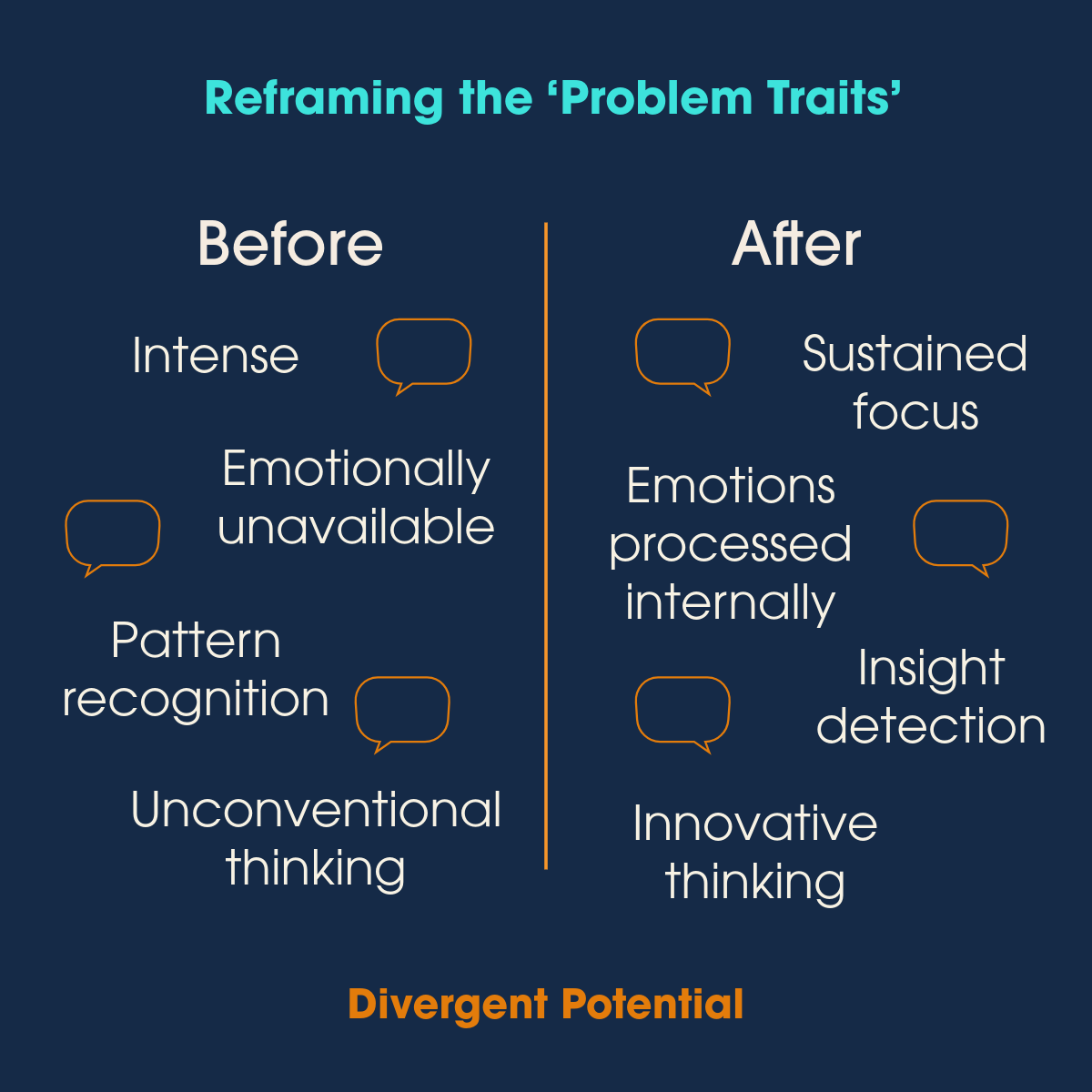
Over years of coaching late-diagnosed AuDHD professionals, I've found that the traits most often framed as problems — the intensity, the pattern recognition, the unconventional thinking, the emotional depth — are frequently the same traits that made them exceptional at what they do.
The difficulty was never the operating system. It was the mismatch between the operating system and the environment it was asked to run in — and the manual it was handed to work from.
Here's what that operating system actually looks like — and why it matters in a leadership context.
-
Autism pulls toward depth — one thing, fully, completely. ADHD pulls toward breadth — everything, simultaneously, now.
The result is a brain that wants to go deep on many things at once. That's both the source of the richest thinking and the most demanding cognitive environment to inhabit.
Starting requires a different kind of ignition. The same depth of focus that produces extraordinary output runs on a different starting mechanism — one that doesn't always respond to conventional productivity logic. Understanding that changes how you design your work, not whether you can do it.
In leadership, associative thinking shows up as strategic clarity. The ability to synthesise across domains, hold complexity, and surface the insight that reframes the whole problem — before anyone else has seen it. It's not a coincidence that many of the most original strategic thinkers I've worked with are AuDHD. The associative reach is structural, not accidental.
-
Autism pulls toward systems and consistency — understanding the rules precisely before deciding whether to follow them. ADHD pulls toward improvisation — rules are suggestions, and the interesting path is always the one not yet taken.
The result is someone who understands the system completely and still can't help finding a better way around it.
Much of that happens beneath the surface — behind a presentation of normality that takes considerable energy to maintain. The thinking is original. The performance of convention is costly. Many late-diagnosed AuDHD professionals have spent years translating their instincts into forms that others find acceptable, without ever being given credit for the translation itself.
In complex environments, that originality isn't a quirk — it's how genuine innovation happens.
When inherited assumptions are questioned naturally, when the brain simply doesn't accept "because that's how it's done" as a sufficient answer, it generates options that consensus thinking closes off entirely. That's not resistance. That's rigour.
-
Autism pulls toward detail and accuracy — every inconsistency noticed, nothing accepted at face value. ADHD pulls toward the big picture — pattern and possibility, less concerned with precision.
The result is someone who sees both the forest and every individual tree simultaneously. As disorienting as it is powerful.
The brain that processes at this level also tends to approach planning, sequencing, and task transitions differently — not as limitations, but as signals about how to structure work in a way that plays to the processing style rather than against it. Executive function operates differently in AuDHD brains. The insight and the administration don't always run at the same speed. That's not a contradiction. It's just the full picture.
For organisations, this means having someone in the room who catches risk, misalignment, and organisational drift before they become problems — without having to try. The discerning AuDHD leader is frequently the person who saw it coming and couldn't get anyone to listen. Getting the conditions right means that changes.
-
Autism pulls toward predictability — sensory and social environment controlled, surprises minimised. ADHD pulls toward novelty — stimulation sought, routine resisted, the new always more interesting than the familiar.
The result is a nervous system that craves calm and seeks stimulation in roughly equal measure — often within the same hour.
That includes the sensory environment. Light, sound, temperature — processed at a different intensity. Not fragility. A nervous system running at higher resolution, picking up signal that others simply don't receive. Time works differently too — a genuinely different relationship with time, where the future feels abstract until it's immediate. When that's understood and designed around, it stops being a friction point and becomes part of a working rhythm that actually fits.
Energy runs in cycles — intense engagement, then recovery. The quiet periods aren't absence. They're maintenance.
In leadership, that attunement produces relational intelligence at depth. Reading what's unsaid, sensing where a team really is, noticing the shift in a room before it becomes a problem. This is the foundation of genuine psychological safety — not as a methodology, but as a natural way of being present. It can't be taught to people who don't feel it. AuDHD leaders often do.
-
Autism pulls toward internalising — emotion processed privately, often delayed, rarely displayed in real time. ADHD pulls toward externalising — emotion immediate, visible, difficult to contain once activated.
The result is someone whose emotional experience is both deeper than most people realise and more visible than they intend. That's a particular kind of exposure to navigate in professional life.
Feedback lands with weight — not as a figure of speech, but as a neurological reality. The gap between receiving criticism and recovering from it can be significant, and it has nothing to do with resilience or professionalism. It has to do with how deeply things are felt, and how seriously the work is taken.
When it's understood, that same depth becomes a particular kind of authenticity that very few leaders carry. Feedback lands harder because the work matters more. Investment runs deeper because the commitment is real. Loyalty is not a word but a practice.
It's the engine behind some of the most principled, driven leadership I've encountered — and why AuDHD leaders tend to inspire unusual levels of dedication in the people around them. Because the people around them can feel that it's real.
Using AuDHD as a Leadership Compass
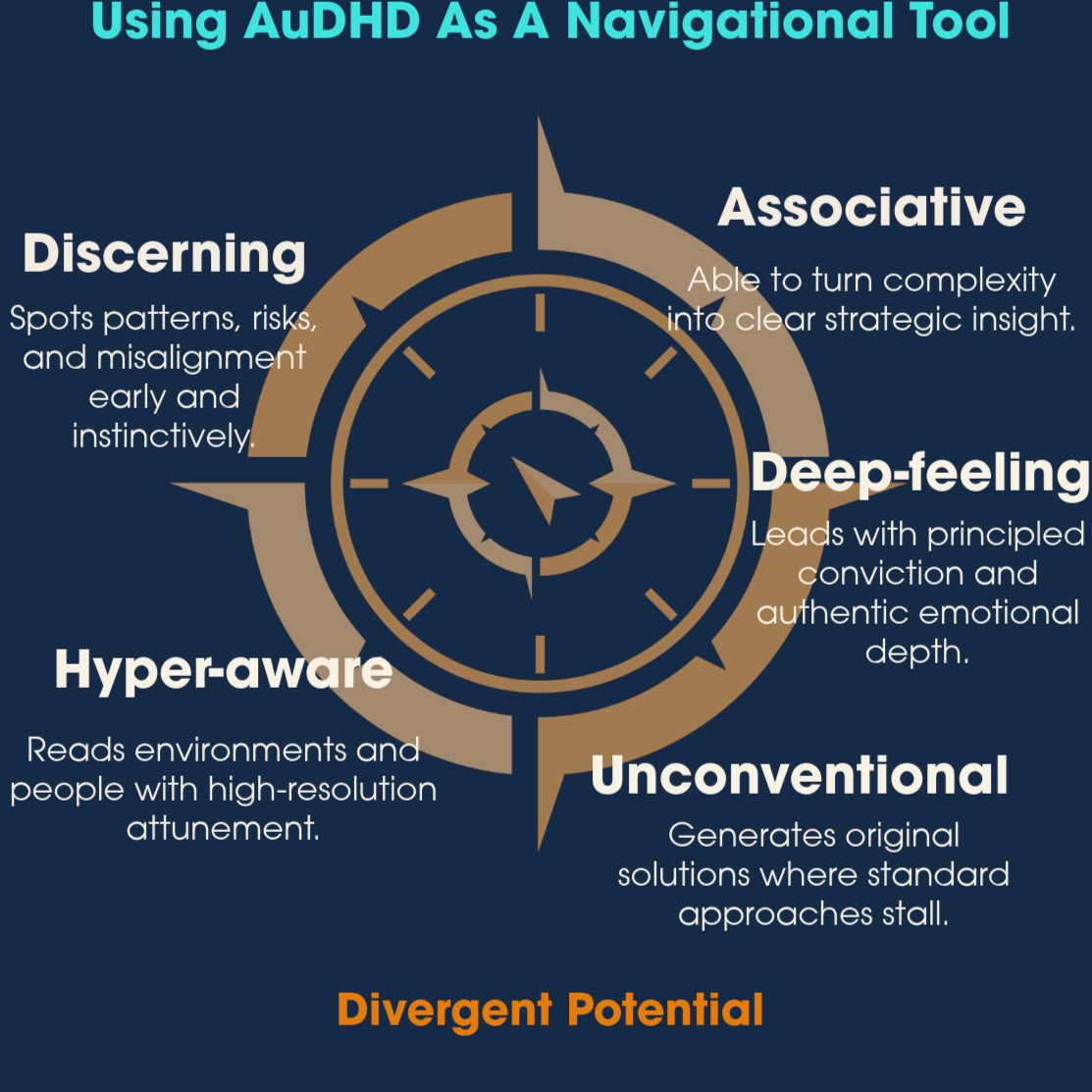
One of the things I encourage the late-diagnosed leaders I work with to do is use AuDHD itself as a navigation tool — not just a label.
When the friction hits. When the activation isn't coming. When the environment is too loud, the feedback too raw, the task too shapeless to start. The acronym is a prompt back to the right operating manual — a way of returning to self-knowledge rather than defaulting to someone else's framework.
Associative — what connections am I not seeing yet? What am I missing because I'm looking at this the way everyone else is?
Unconventional — am I trying to solve this the way someone else would? What would my instinct say if I trusted it?
Discerning — what is the pattern here that I haven't named yet? What is my nervous system already telling me?
Hyper-aware — what does my environment need to be right now for me to think clearly? What cycle am I in?
Deep-feeling — what does the intensity of this tell me about what actually matters? What is the feeling pointing toward?
That's not a workaround. That's self-knowledge being used deliberately — which is precisely what the best leaders do, regardless of neurotype. The difference for AuDHD leaders is that the self-knowledge is harder won, more precise, and — once accessed — more useful than most people realise.
AuDHD Executive Coaching: Who This Work Is For
I work with senior professionals and leaders who are often late-diagnosed, frequently underestimated, and rarely operating with an accurate manual for how they actually think.
The executive coaching work at Divergent Potential isn't remedial. It isn't about managing symptoms or working around deficits. It's about building the right operating manual — one that's accurate to how you actually process, decide, and lead — and creating the professional conditions in which that performs at its best.
If you're a late-diagnosed AuDHD leader wondering whether the way you work is an asset or a liability, the answer is almost always both. The work is learning to tell the difference — and designing accordingly.
You might also find it useful to explore the FRICTION Framework — a coaching model developed specifically for AuDHD professionals navigating the tension between how they think and how the world expects them to operate.
Start the Conversation
Whether you're navigating a late AuDHD diagnosis yourself, leading a team with a neurodivergent professional you want to support more effectively, or simply recognising something in this framing that you've never quite had the language for — I'd welcome a conversation.
Divergent Potential works with senior leaders and executives across sectors. Initial consultations are always a conversation, not a pitch.
Book an initial consultation or reach out directly at info@divergentpotential.com