
Why capable leaders consistently underdeliver in the conversations that matter most — and what changes when you understand the architecture.
You're not underperforming.
You're being intercepted before the conversation has started.
You'd prepared. You understood the room. By any measure, you were ready.
And yet something shifted. You softened the challenge. Added a qualifier that undermined the point. Left the room knowing it hadn't landed the way it should have.
The automatic response is equally familiar: I need to get better at this.
Sit with that for a moment, because that instinct, however understandable, is aimed at the wrong problem. The issue isn't capability. The issue isn't effort. The issue is that something intercepted the gap between what you're capable of and what the room received.
For neurodivergent leaders, this pattern shows up consistently in high-stakes communication and it has a precise explanation. It starts before you've said a word.
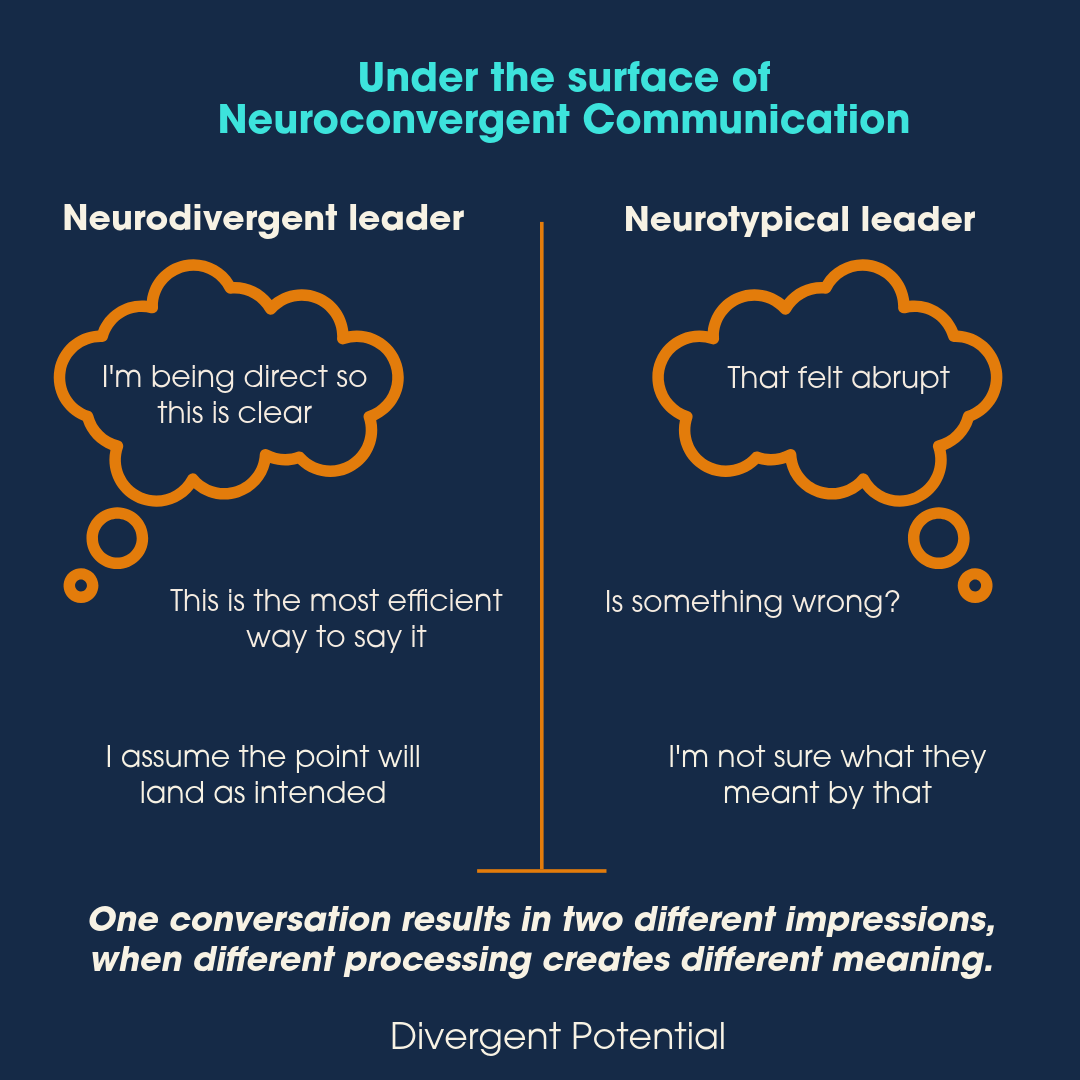
Two Different Minds. One Conversation.
Most professional communication assumes a shared operating system.
Same inferential shortcuts. Same social norms. Same instinctive reading of tone, pace, and subtext.
For neurotypical professionals communicating with other neurotypical professionals, that assumption roughly holds.
For neurodivergent leaders, it doesn't.
This is the starting point for neuroconvergent communication: not the gap between neurotypes, but the conditions that make genuine meeting across that gap possible.
When two people with different neurotypes communicate, the gap between how each person makes meaning tends to produce misreading on both sides — not as a failure of either party, but as a predictable result of two coherent but different operating systems meeting without a shared translation layer.
The communication didn't fail because you failed. It failed because convergence (the genuine meeting between different minds), is harder than it looks. And almost nobody is taught how to create it.
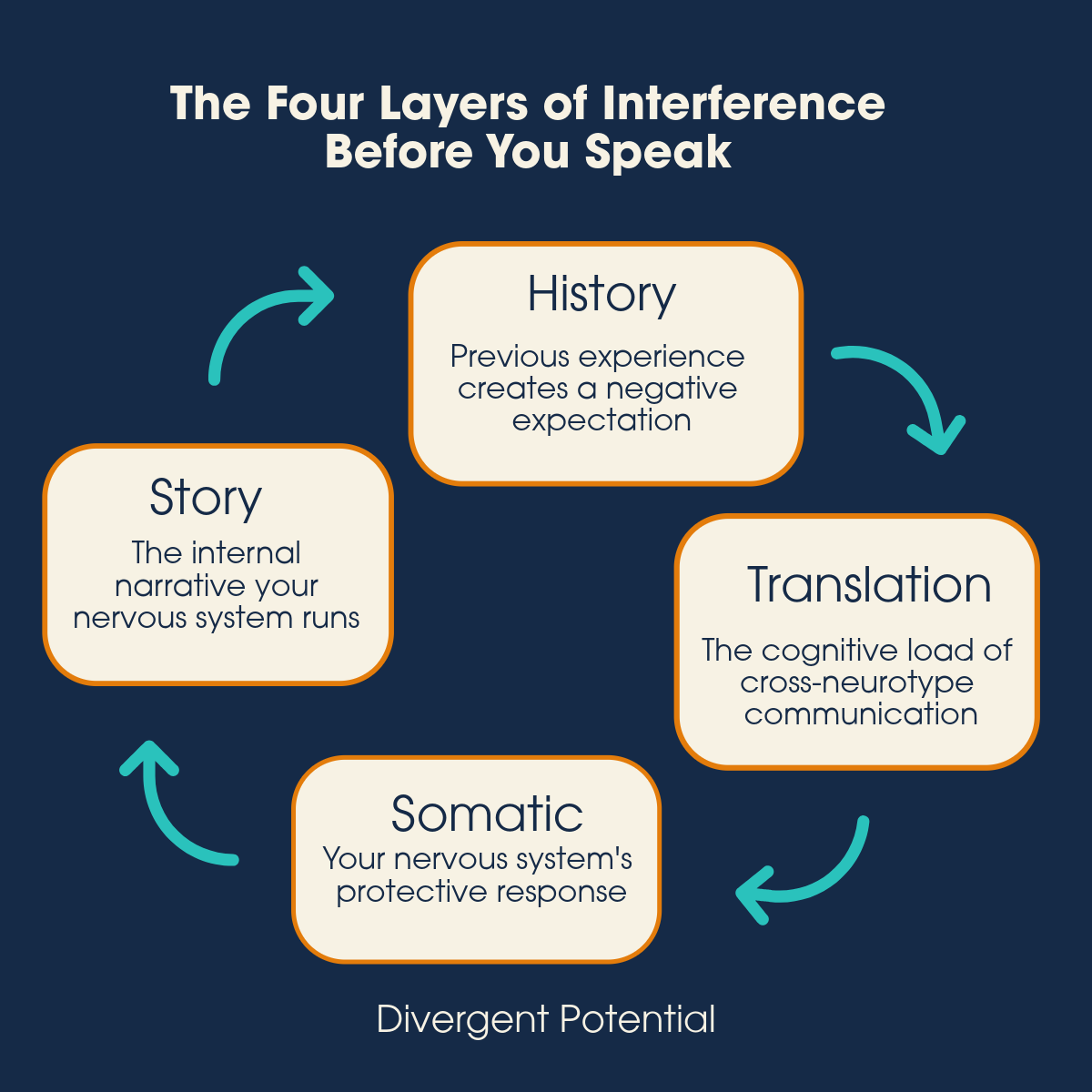
What Gets in the Way of Neurodivergent Communication Before You've Said a Word
For neurodivergent professionals in leadership roles, this is where high-stakes communication work needs to start.
By the time a conversation begins, four layers of interference are already running. They don't operate in isolation, in fact each one feeds the next. Understanding them separately is the first step to interrupting them.
Layer 1 — History: Your past is already in the room
Every previous interaction where you were misread, dismissed, or quietly written off as difficult has been logged by your nervous system. You walk in carrying that data whether you intend to or not.
The body has already made its assessment before your brain has had a chance to contribute.
This layer is about specific events: the accumulated weight of particular moments. It's the trigger. What fires next is Layer 3. But first, something else is consuming your bandwidth in real time.
Layer 2 — Translation: The Hidden Cost of Cross-Neurotype Communication
Neurotypical social communication runs on inferential shortcuts, such as indirectness, face-saving norms and pace-reading that most NT people process automatically. For neurodivergent professionals, that processing is manual. You're tracking the content of the conversation and running a parallel translation process at the same time. The cognitive load is real, constant, and invisible to everyone in the room except you.
This isn't about the past or the future. It's happening in every exchange, quietly consuming the bandwidth that should be going to the conversation itself. It is one of the least visible costs of neurodivergent leadership, and one of the most significant.
Layer 3 — Somatic: Your nervous system fired before you noticed
Layer 1 loaded the historical pattern. Layer 3 is what the body does with it.
Social communication is a whole-body event, not just a cognitive one. Many neurodivergent people process bottom-up, so the body registers threat before the mind catches up. The nervous system responds to the pattern data from Layer 1 before conscious awareness has had a chance to intervene.
By the time you notice you're diluting your message, the protection response has already fired.
The behaviour you're criticising yourself for is downstream of something that happened earlier (and faster), than thought.
Layer 4 — Story: The Narrative Your Nervous System Is Running
This layer is about what the experiences from Layer 1 told you about yourself — and that distinction matters enormously, because this is where the deepest work occurs. Years of feedback — direct or indirect — telling you the communication problem was yours. That you were too much, too blunt, too intense, too hard to read. That feedback felt like data. It wasn't. It was a bidirectional mismatch — two neurotypes failing to reach each other — attributed to one side only. The nervous system doesn't fact-check its sources. It just runs the pattern. Unlike the wiring of Layer 2 or the physiological reality of Layer 3, this layer is acquired. Which means it's changeable. It responds to evidence. It's where the most leverage lives — and where accurate understanding of what actually happened begins to rewrite the programme.
Why This Matters for Neurodivergent Senior Leaders
The higher you go, the more your impact depends on communication rather than technical execution.
For neurodivergent senior professionals, that's often where the gap opens. Not in capability or in strategic thinking, but in the consistent translation of that capability into influence, credibility, and outcomes in the interactions that matter most.
In practice that means working upstream of the conversation itself, on skills such as regulation, accurate attribution, and the conditions that make genuine choice possible in the moment.
That's a precise problem. It has a precise solution. And it's one that generic executive coaching without this depth of understanding rarely reaches.
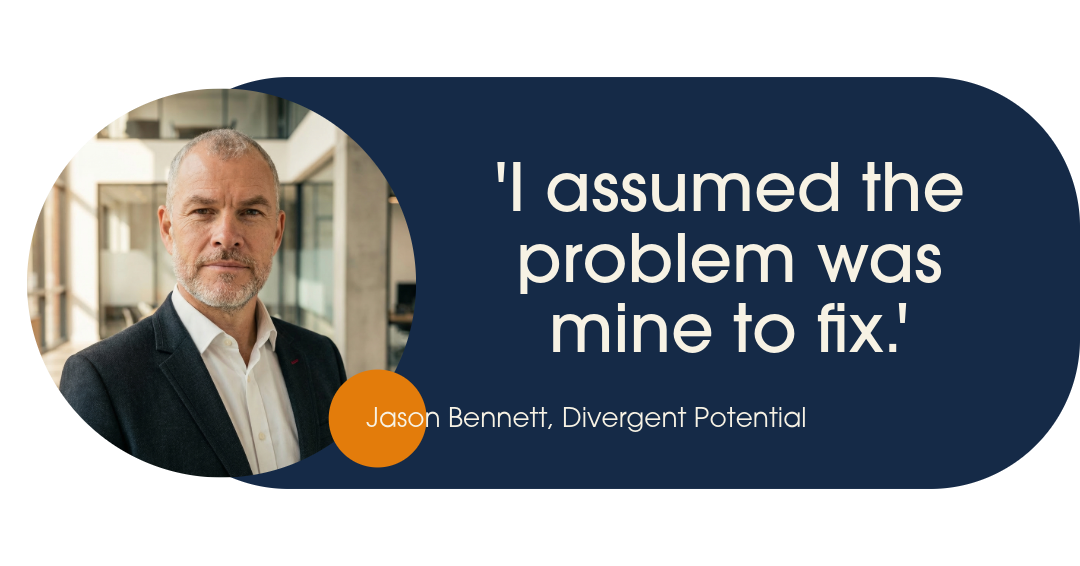
For most of my career I was the neurodivergent professional in the room who didn't know that's what I was. I knew the conversations weren't landing the way they should. I assumed the problem was mine to fix.
It took a late diagnosis and years of working with the research and frameworks in this post to understand what was actually happening. Convergence between different neurotypes is possible. It isn't automatic. It requires understanding what's running beneath the surface of every high-stakes conversation, on both sides. But when that understanding is in place, something shifts.
Not toward conformity or one neurotype performing the other's norms, but towards genuine meeting, where different minds actually reach each other. That's neuroconvergent communication. And it starts with understanding what's been getting in the way.
When you understand this architecture, it doesn't just stay in the office. It changes how you show up with your partner, how you navigate conflict with people you love and how much of yourself you stop leaving at the door. Cross-neurotype communication is the human condition for neurodivergent people. Getting better at convergence doesn't just improve your career, it improves your life.
-
Neuroconvergent communication refers to genuine understanding and connection between people with different neurotypes — not one side adapting to the other, but both sides developing enough awareness of the gap to actually reach each other. It's distinct from masking or code-switching because it doesn't require either party to perform norms that aren't natural to them.
-
The difficulty isn't usually a skills gap. For most neurodivergent leaders, four layers of interference run before a high-stakes conversation has started: accumulated history of being misread, the cognitive load of real-time translation across neurotypes, somatic protection responses that fire faster than conscious thought, and an acquired story about being the problem. Understanding which layer is running — and why — is where the work begins.
-
Cross-neurotype communication describes any exchange between people whose neurological wiring differs significantly — most commonly between neurodivergent and neurotypical professionals. The research (notably Damian Milton's Double Empathy Problem) shows that misreading runs in both directions: it isn't a deficit in either party, but a collision between two coherent but different ways of making meaning.
-
Standard executive coaching typically addresses communication at the level of skills, framing, and strategy. Neuroconvergent executive coaching works upstream of the conversation itself — on regulation, accurate attribution of what's actually happening, and the specific interference patterns that intercept neurodivergent leaders before they've had a chance to perform at their actual level. The four-layer framework in this post is one example of what that looks like in practice.
-
Yes — with the right framework. The starting point is understanding the architecture: which layers are running, why they interact the way they do, and where the most leverage lives. Layer 4 (story) is where the deepest change occurs, because unlike neurological wiring or physiological responses, it's acquired — which means it responds to evidence and can be rewritten.