
Executive Leadership After a Late ADHD or Autism Diagnosis: What Changes Next
Something shifted when you got the diagnosis. Your leadership hasn't caught up yet.
For late-identified neurodivergent leaders at senior level, those navigating a late ADHD, autism, or AuDHD diagnosis alongside an established executive career, the period after identification tends to follow a recognisable pattern, even when nothing about it feels recognisable at the time.
The relief lands first, that part is almost universal.
Decades of spotting patterns, ones that never had a satisfying explanation, that you attributed to character flaws or insufficient effort or simply the price of being who you are, suddenly take on new meaning. Processing this reframe takes time, reflection and energy. Most late-identified leaders describe it as one of the more significant things that has happened to them.
And then, not long after, something more complicated begins to surface.
For many it arrives with an unexpected edge, or something closer to grief than relief.
Not for what's been lost exactly, but for what was built without the right information. And underneath that, quieter but persistent: the recognition that the hope things would eventually just click, or that the friction would resolve itself once you'd found the right role, done enough work, built the right conditions, was based on a version of yourself that wasn't quite complete.
Some of what you were waiting to resolve isn't going to resolve on its own.
That's not a counsel of despair. It's the beginning of something more useful.
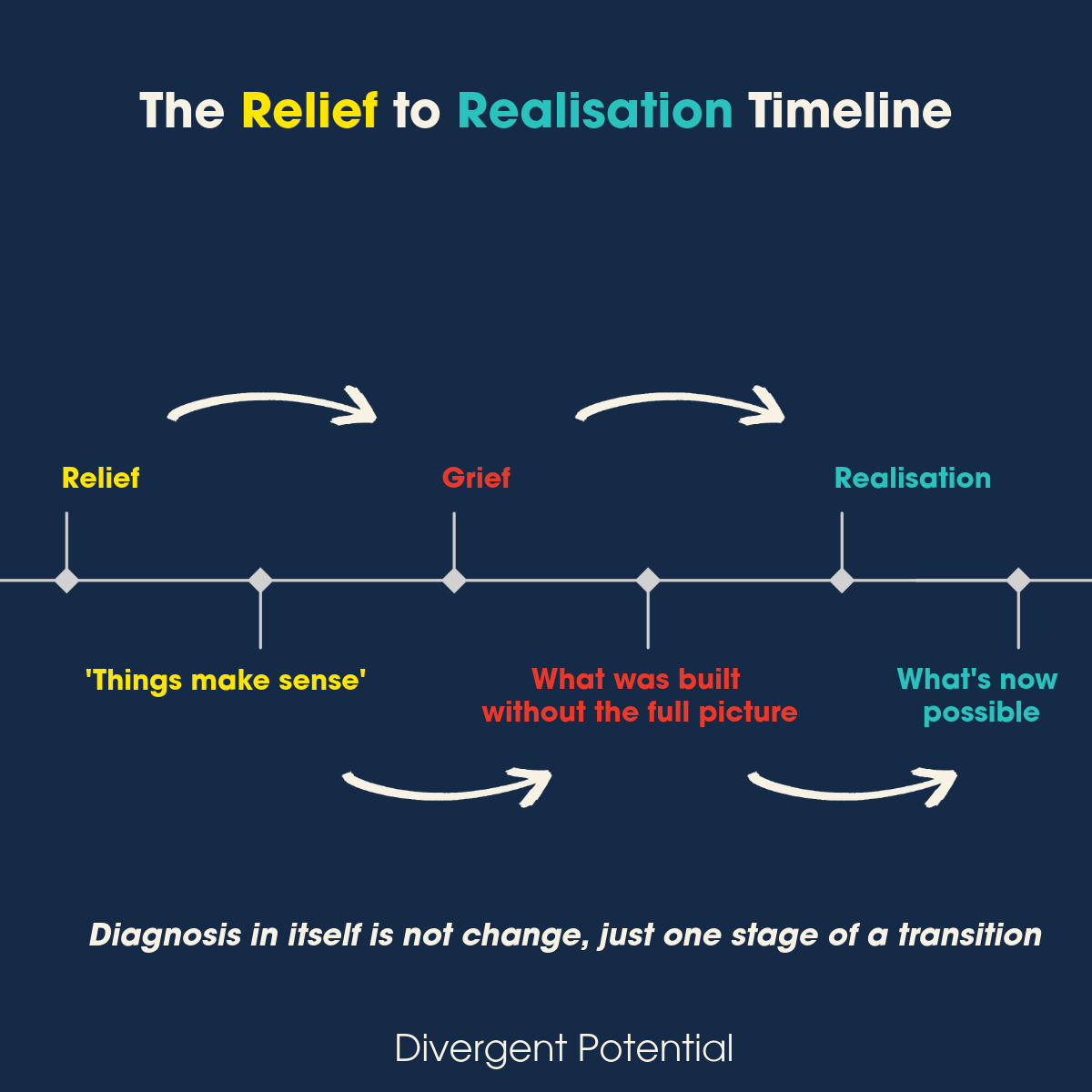
What you're actually looking at when the diagnosis lands
There's a specific quality to how late-identified senior leaders revisit their professional history after a late ADHD or autism diagnosis. It isn't regret, exactly. It's more like reading a document you wrote in the dark and seeing, now that the lights are on, what you were actually doing.
The compensation strategies that got you to VP level, to the board, to wherever you currently sit were never random. They were sophisticated. Built over years of implicit learning about how to perform in environments that weren't designed for how you think.
The fact that they worked is evidence of considerable capacity.
But they were compensations. And knowing that changes how you relate to them.
Some of what you attributed to resilience was resilience. Some of it was cost. The two look similar from the outside and feel similar from the inside until you have the framework to tell them apart. Knowing which is which matters. Not as a retrospective audit, but because it directly affects what you build next and on what terms.
The temptation here is to measure what the diagnosis cost you. That's a recognisable and entirely understandable response, and it deserves space. But it's a different question from the more useful one, which isn't what was lost, but what becomes possible now that you're working with accurate information for the first time.
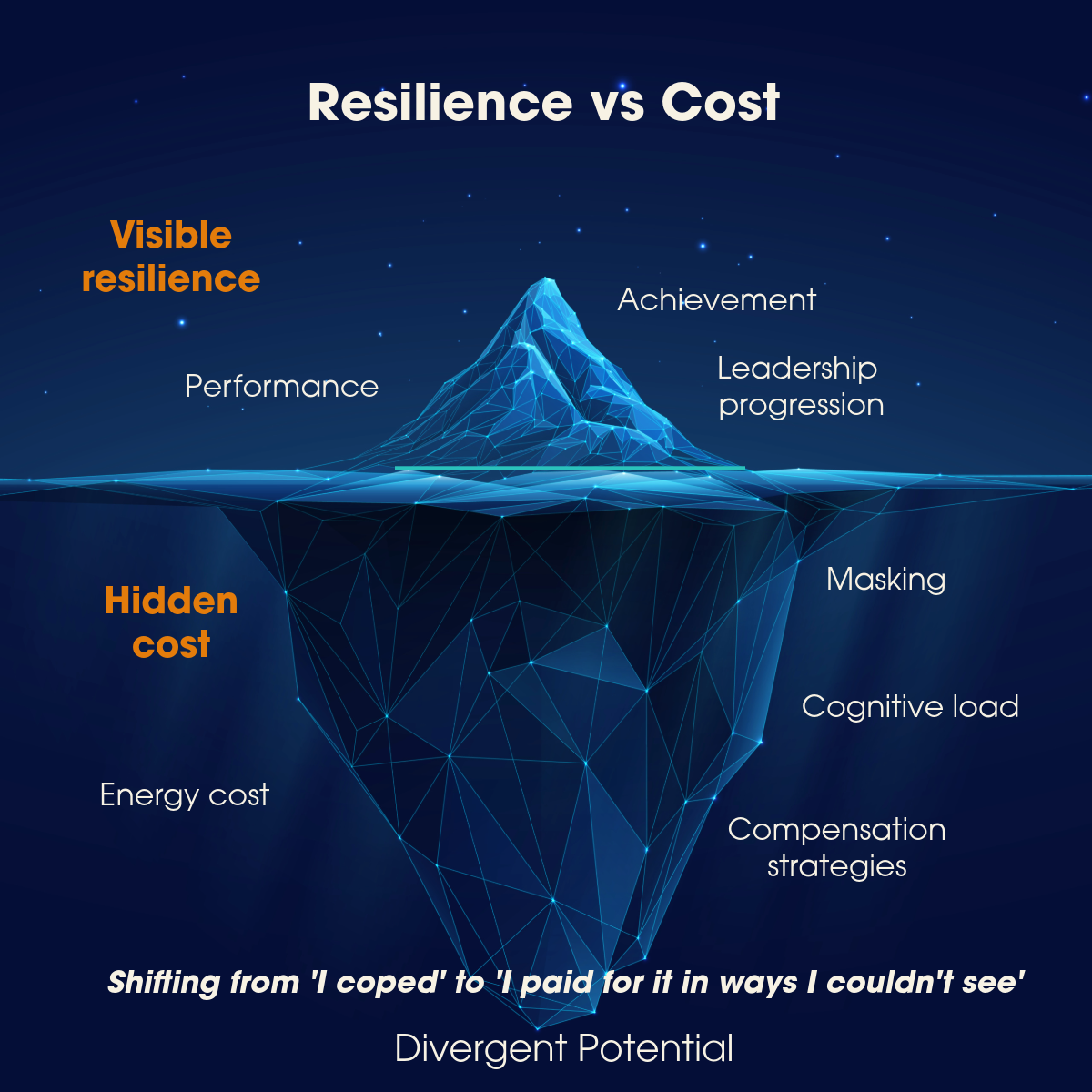
Why understanding it isn't the same as changing it
Late identification gives you something most leaders never get: an honest framework for how you actually think, process, and make decisions. That accuracy is genuinely useful. It's also, for many senior leaders, the first time they've had real access to it.
What it doesn't give you is an automatic answer to what comes next.
Understanding your architecture isn't the same as redesigning how you operate within it. Diagnosis is not change. The strategies that carried you to this level don't stop being the default just because you can now see them clearly. And there are real constraints to navigate.
These aren’t limitations that define the ceiling of what's possible, but features of how you're wired that work better when designed around than when ignored or overridden.
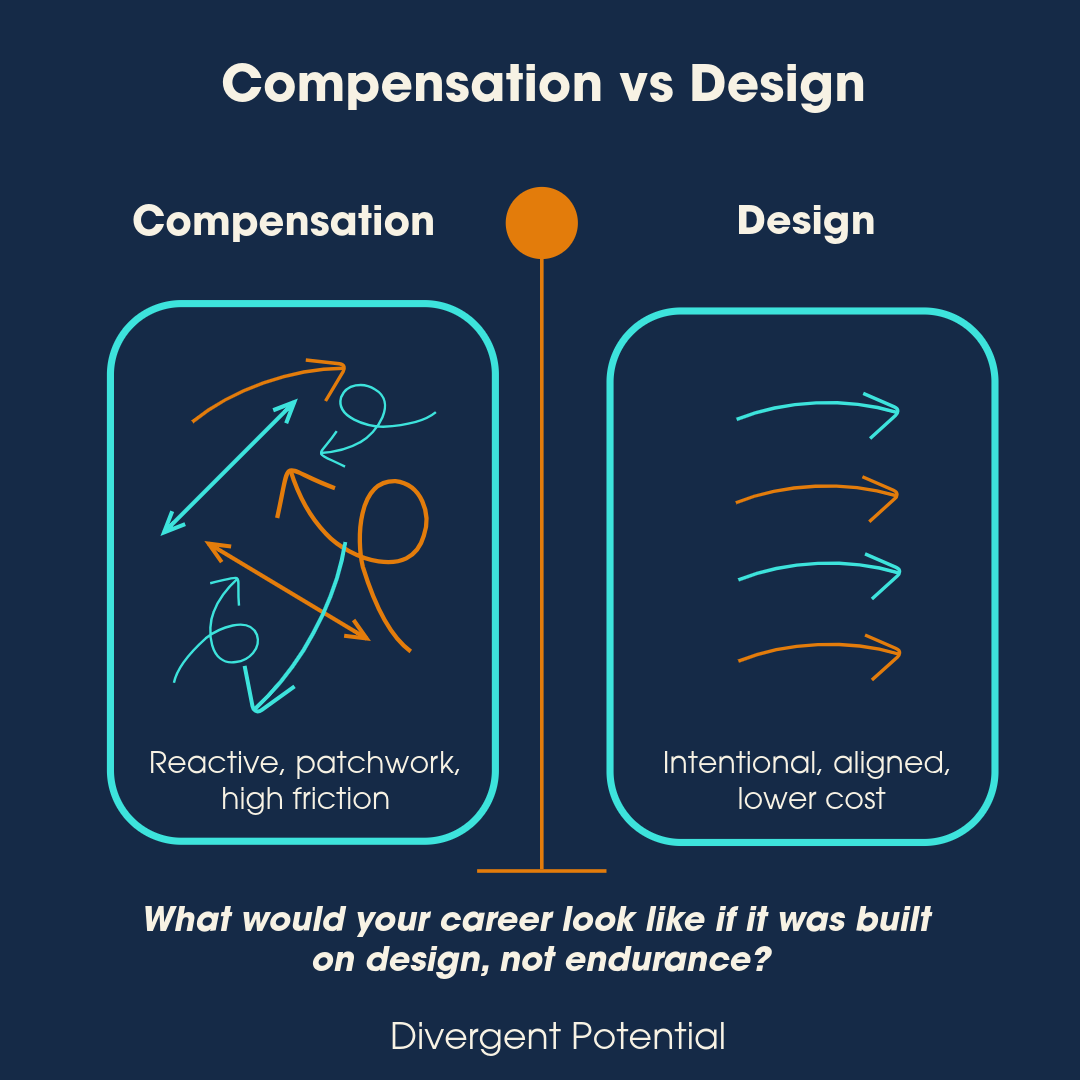
The leaders who do this well aren't the ones who transcend their wiring. They're the ones who stop fighting it and start building with it deliberately. That distinction sounds simple. In practice, after decades of doing the opposite, it requires a specific kind of work, and a specific kind of relationship in which to do it.
Most executive coaching wasn't built for this. It was built around a model of how leaders think and operate that doesn't account for this level of complexity. It produces useful results on the surface and incomplete ones underneath. Sessions may address behaviour, but they’ll leave the architecture that drives it entirely unexamined. Most neurodiversity support, meanwhile, doesn't operate at this career level or with this degree of professional nuance.
Research consistently finds that late-diagnosed adults, whether ADHD, autistic, or AuDHD, report masking all or most of the time in professional settings, primarily to advance their careers. At senior level that masking doesn't diminish with seniority. It compounds. And the cost of sustaining it quietly is rarely visible until it stops being manageable.
The leaders who find something that holds both the executive development work and the identity integration work tend to describe it as the professional conversation they'd been waiting for without quite knowing it.
Executive coaching for late-diagnosed ADHD and autism leaders — what the work actually is
The leaders I work with at this level (primarily across the UK, though the experience is far from uniquely British) are nearly always performing well on the outside. The question they're carrying is quieter than crisis, and more precise.
It's not ‘can I keep doing this?’ It's ‘what would this look like if I stopped building it on endurance and started building it on design?’ There’s a different depth to that question, so it opens up a different depth of work.
That work is rigorous. It involves honest examination of what's driving friction that's easy to attribute to external factors. It involves distinguishing precisely between what was genuinely yours and what was the cost of the environment's version of you, because getting that wrong in either direction is expensive. And it involves working out what the next chapter of your leadership looks like when it's constructed around how you actually operate, not around the template the environment defaulted to.
The most important leadership development conversations are often the ones nobody around you is currently equipped to have with you. At senior level the peer group is small, honest challenge is scarce, and the specific complexity of late identification sits outside the experience of most people in the room. But that gap is real. And it's addressable.
Where to start
The shift from endurance to design doesn't happen in one conversation. But it does start with three things that are within reach before anything else changes.
Get accurate about the cost. Not as a grievance exercise, but as a practical audit. What's actually friction from your environment, and what's friction you're generating by working against your own grain? Most late-diagnosed senior leaders have never separated these cleanly. Doing so changes what you decide to address and what you decide to redesign.
Stop treating compensation as capability. The strategies that got you here were sophisticated. They were also load-bearing in ways that are now optional. Identifying which is which — what was genuine strength and what was workaround — is where the rebuilding actually begins.
Find the right container for the work. This level of professional complexity requires a specific kind of thinking partnership. Not coaching that treats neurodivergence as a footnote. Not neurodiversity support that doesn't operate at executive level. The conversation that holds both is less common than it should be, but it exists.
The shift most leaders notice isn't in what they're capable of. That was always there. It's in what it costs to express it.
If this is the conversation you've been waiting for, that work starts here.
Jason Bennett is an ICF ACC and ADDCA AACC credentialed executive coach specialising in executive coaching for neurodivergent professionals — working with late-identified ADHD, autism, and AuDHD leaders across the UK at divergentpotential.com