
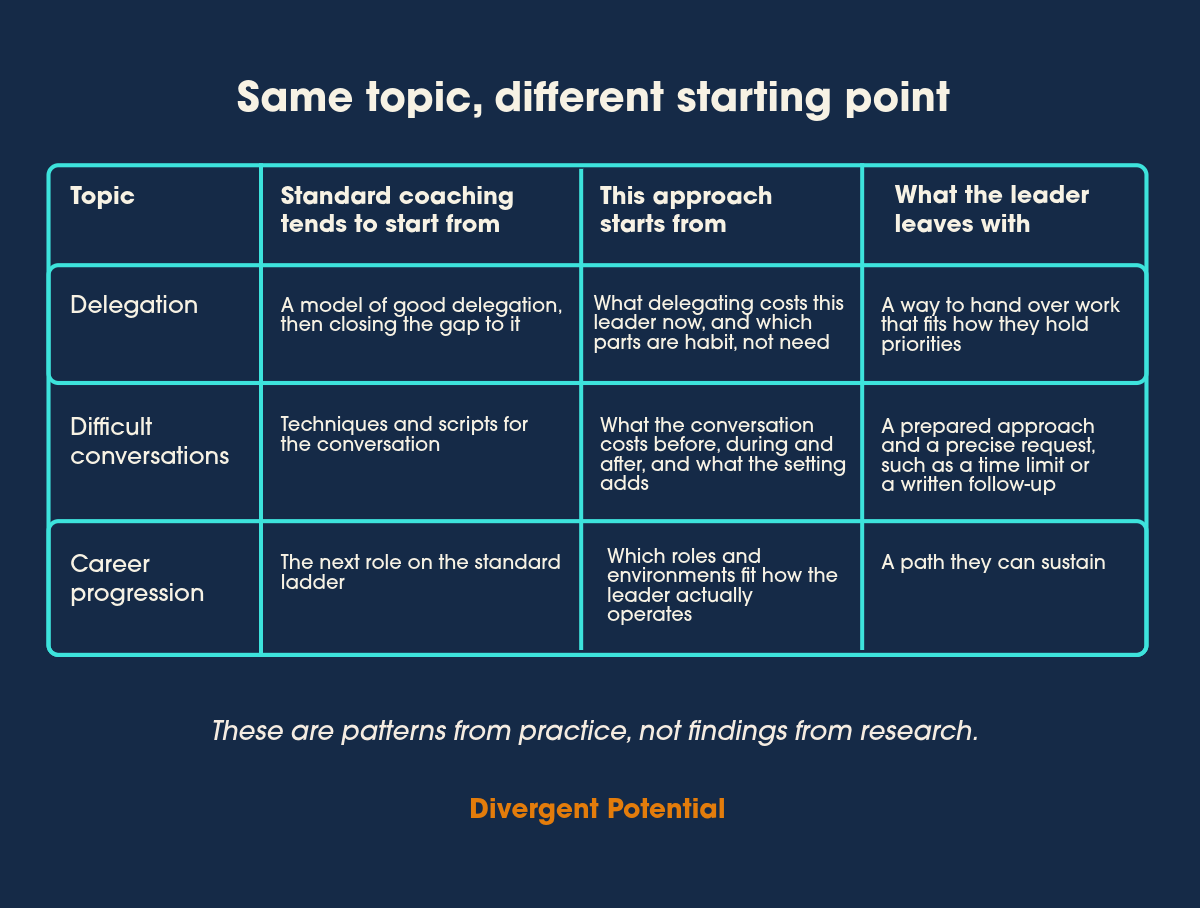
The topics are the same. The starting assumption is not.
Standard coaching tends to treat the environment as fixed and works on the person. This approach asks every time which should change, the person or the setting.
The result is a plan that costs the leader less, and requests an organisation can act on. Everything below follows from that question.
If you are choosing a coach, or choosing one for someone on your team, you will hear the same thing from most providers.
The topics are the same.
They are. Leadership presence. Delegation. Strategic thinking. Difficult conversations. Career progression.
And yet the coaching is not the same.
The difference is not the agenda. It is what the coaching treats as fixed, and what it treats as open.
Put simply: standard coaching tends to change the person to fit the setting. This approach asks, every time, which of the two should change.
That is the whole difference. The rest of this piece shows where it appears.
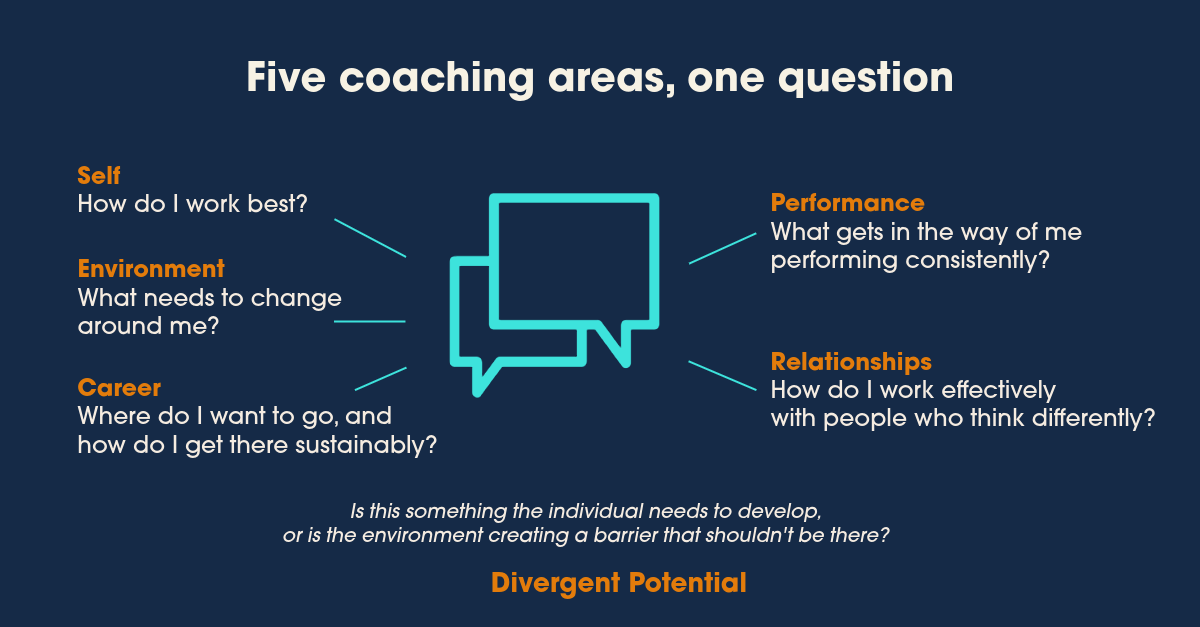
Five areas, one question
I think about the work across five areas.
Self. How do I work best?
Performance. What gets in the way of me performing consistently?
Relationships. How do I work effectively with people who think differently?
Environment. What needs to change around me?
Career. Where do I want to go, and how do I get there sustainably?
One question sits under all five.
Is this something the individual needs to develop, or is the environment creating a barrier that shouldn't be there?
Standard coaching tends to skip the environment half of that question. That is the default assumption of the model, not a flaw in any one coach.
Why the question matters
Skip the question and neurodiversity coaching quietly becomes something else. How do we make this person behave more neurotypically?
That is compliance with better language. It does not last.
45% vs 30% In a CIPD survey of over 1,000 employed adults, neurodivergent employees were more likely than neurotypical employees to say they always or often feel exhausted.
A survey cannot tell you why. It does show the context coaching sits inside.
Five things follow from that starting point. Each is a place where the difference shows up in the room.
1. It counts the cost nobody measures
If the environment is open to question, the cost of working in it has to be counted.
An ADHD, autistic or AuDHD senior leader can do almost anything. Not everything, and not for free.
The same task that is cheap for most people can be expensive for someone wired differently. Back-to-back meetings. Holding five priorities in working memory instead of writing them down. Filtering a noisy office all day.
Most people never see the cost, because the leader has adapted to paying it. They work the way the majority does because that is what was modelled. It is not because it is the only route to the outcome.
I know this from the inside. I spent years running at a cost I didn't know I was paying.
Often there is a cheaper route to the same result. Different, not worse.
Finding it is frequently the real coaching work.
2. It tells adaptation from masking
The environment question is what separates them. Is the person choosing this, or is the setting demanding it?
From the outside, they can look identical.
A leader softens their tone before a difficult conversation. A leader rehearses scripts before every meeting. One is a choice that serves the leader's own outcome. The other is exhausting self-erasure. Often it is the same behaviour. The difference is whether it was chosen or defaulted into.
The research on masking points the same way. A systematic review of 29 studies found that higher self-reported camouflaging is associated with worse mental health outcomes. Most of that evidence is cross-sectional, so the direction of cause is not established.
Acas guidance makes a related point from the employer side. People may not need to mask as much when they feel comfortable at work. That is the environment question again.
The coaching starts by telling the two apart.
3. It holds strengths and difficulties together
In my experience, many ADHD, autistic and AuDHD leaders are strong at pattern recognition, sustained focus, lateral thinking and seeing connections others miss. I treat those as observations, not slogans.
The point is sequencing. Strengths raised after the difficulties become consolation. Weighed together, they become design material. What to build around. What to protect.
Acas says employers should explore strengths with neurodivergent workers, alongside the adjustments that reduce the load.
4. It treats self-advocacy as coaching work
If the setting is part of the problem, someone has to be able to say so.
Working out what is actually difficult, what would help, and how to raise it with a manager is coaching work. It is not a referral elsewhere.
The aim is a precise request, not a full disclosure. The N.A.M.E. Script is one tool for it.
Relationships belong here too. Communication gaps between autistic and non-autistic people are increasingly understood as relational, not solely an autistic deficit.
5. It ends in a testable change
"I struggle with prioritisation" is an insight. It is not a plan.
A plan is specific and testable. For one week, write three priorities before the first meeting and check them at 4pm. Review it the following week. Did it work? Why? What changes?
That is the difference between coaching and being told about neurodiversity.
What changes
Because both the person and the setting are open, the benefit lands in two places.
For the leader
The hidden load drops. A cheaper route to the same result replaces an expensive default.
Requests get precise. "I need the agenda 24 hours ahead" is something a manager can act on. A general disclosure is not.
Career decisions rest on an accurate picture of how the leader works, not on what was modelled.
The aim is a way of working that fits the person, so it can be sustained.
For the organisation
Barriers in the environment get named, so they can be fixed instead of absorbed. The Hidden Performance Tax post covers how that cost hides in the metrics.
Leaders can say what they need. In an Acas survey of 1,650 managers, 72% said that employees not disclosing a need for adjustments was a significant obstacle.
Coaching sits alongside adjustments, manager training and policy. It does not replace them.
What the evidence does and does not say
Research on coaching for ADHD adults is encouraging but thin: around twenty studies, three of them randomised trials, mostly with college students. For autistic professionals it is thinner, with one small qualitative study of four employed people. None of this tests the approach described here as a whole. It is practice, informed by research, not proof.
Five questions to ask any coach
Do you ask whether the environment is the barrier, or only what the person should change?
How do you tell adaptation from masking?
What will be different by next week?
Is self-advocacy part of the sessions, or a referral?
What evidence do you draw on, and how do you describe its limits?
Accurate foundations
So, the difference. Standard coaching changes the person to fit the setting. This approach asks which should change, and builds the plan on the answer.
None of this is about fixing anyone.
It is about building accurate foundations, so a leader can lead on their own terms.
If you want somewhere to start, The Ambiguity Gap and The N.A.M.E. Script are both free.
If you are a senior leader and this reads like your week, see how the coaching works. Or book a free discovery call.
If you are commissioning coaching for leaders in your organisation, see the organisational coaching.
Jason Bennett is the founder of Divergent Potential, an executive coaching practice specialising in ADHD, autistic and AuDHD senior professionals and leaders. He spent 25+ years in technology leadership, starting as a software engineer and progressing to VP level, and brings his own late AuDHD diagnosis to the work. He holds ICF ACC and ADDCA AACC coaching credentials.