
Define the outcome. Leave the route open. Put the right support alongside.
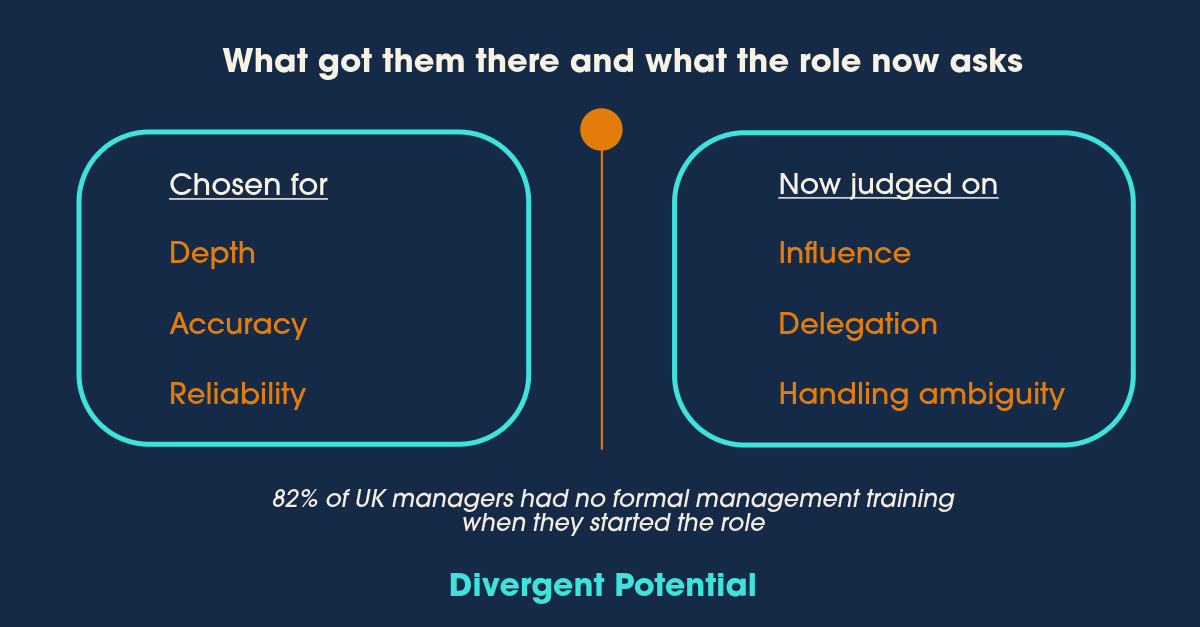
You appointed a strong individual contributor to lead. The person is the same. The job is not. They were chosen for depth, accuracy and reliability. Now they are judged on influence, delegation and how they handle ambiguity. Nobody says so.
In the UK, more than four in five managers had no formal management training when they started the role. For neurodivergent professionals, leaving the transition to chance costs more.
From authority to influence
As an individual contributor, expertise is your authority. People defer to what you know.
When you are promoted to manager, or hired into the role, that lever weakens. Success depends on people who may not report to you, and who may not share your view.
The skills involved are rarely taught as skills. They tend to be read as personality. So a capable person starts to look as though they are struggling, when the real problem is that nobody defined the job.
The same applies to a new job. You arrive with the new role and a new organisation: new colleagues, new unwritten rules and no track record to lean on.
Why it lands harder for autistic and ADHD leaders
It is tempting to read this as a skills gap. Influence, delegation and stakeholder management can all be learned, and they matter.
But it is not only skills. Leadership happens in environments built around one communication style and one set of social norms. A neurodivergent leader works across that difference every day. The cost builds up, and it rarely appears in a job description. The CIPD found that neurodivergent employees are more likely to feel exhausted at work: 45% against 30% of neurotypical employees.
Roughly a third of the leaders I work with arrive at exactly this point. A strong individual contributor, moved into technical management, now running into friction over communication.
I know this from the inside. I spent more than 25 years in technology leadership, from software engineer to VP. Every promotion felt like proof I wasn't the problem. I pushed through and delivered, privately running at a cost I couldn't fully account for until my late diagnosis.
Support usually arrives late
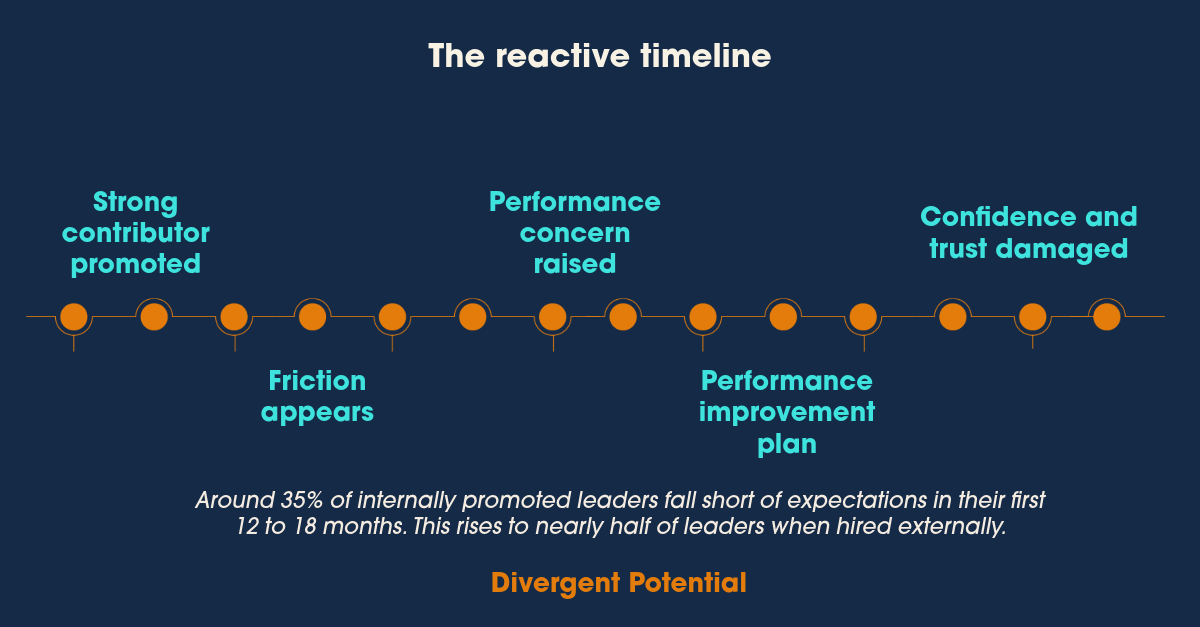
The usual response is reactive. A performance concern is raised. A performance improvement plan follows. Confidence and trust take the damage. In some cases the person is let go, and the organisation loses the strengths it chose them for.
One study of newly promoted senior leaders found the same pattern in transition support. It tends to be used reactively, to start too late, and not to continue for long enough.
The stakes are not small. DDI research found that around 35% of internally promoted leaders, and nearly half of those hired from outside, fall short of expectations in their first 12 to 18 months.
The line manager cannot carry it alone
The person managing the appointment has a day job. They are rarely equipped for this either. Only 24% of organisations train line managers to support neurodivergent team members.
Organisations bring in lawyers, auditors and search firms without apology. Nobody expects a line manager to learn those fields on the side. A leadership transition is no different.
Set the outcome. Leave the route open.
The most useful thing an employer can do is define what success looks like, then resist prescribing how to get there.
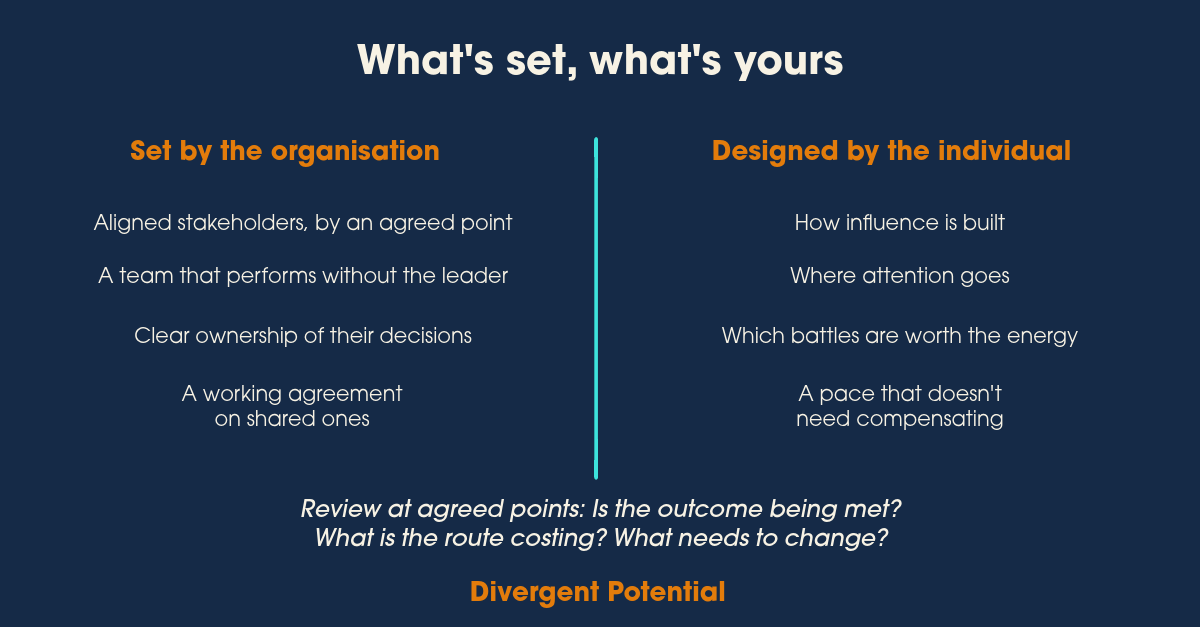
At senior level, outcomes are specific. Stakeholders aligned behind a direction by an agreed point. A team that performs without the leader at the centre of every decision. Clear ownership of the decisions that are theirs, and a working agreement on the ones that are shared. Agreed early, these give the person something concrete to aim at, and the organisation something to review against.
The route is the individual's to work out. A neurodivergent leader rarely needs to be told what the role requires. They need room to design how they will meet it: how they build influence in a way that fits their values, where their attention should go, which battles are worth the energy, and how they sustain a pace that doesn't depend on compensating. That is personal work. It goes better with someone alongside who has led across the same difference, and who has the time to work through it with them.
That is the case for bringing in specialist support. It lets the manager stay a manager. They set the outcome and review progress, and they are not asked to guess what works for someone else.
Then review on evidence. At agreed points, ask whether the outcomes are being met, what the route is costing, and what needs to change, in the role or in how it is being done. Sometimes the answer is to adjust the arrangements. Sometimes it is to hold course. Either way, the decision rests on what is happening, not on how hard anyone is trying.
If you are the one being promoted
You do not have to wait to be offered this. Ask for it as part of the appointment. If you are joining a new employer, ask for it as part of the offer.
Ask for three things. A clear brief of what success looks like. A named person to think things through with, who understands how you work. And a date to review how it is going. These are reasonable requests, and most employers will welcome them.
Make it part of the appointment
They were chosen for what they can do. Back them in what the role now asks.
Define the outcome. Leave the route open. Put the right support alongside.
Executive coaching for autistic and ADHD leaders
If you are planning a promotion or senior hire like this, or have just made the move yourself, book a free 30-minute discovery call.
Jason Bennett is an executive coach for autistic and ADHD senior leaders. ICF ACC, ADDCA AACC, with more than 25 years in technology leadership, from software engineer to VP.