
You’re at the Top of Your Game.
So Why Does This Feel Like the Hardest It’s Ever Been?
Success isn’t supposed to feel heavier at this stage. So why does it?
You’ve built the career. The track record is there. The seniority, the responsibilities, the kind of room you’re now invited into — all of it reflects years of sustained, high-level performance.
And yet.
There’s something in how it feels right now that the metrics don’t quite capture. Not a crisis. Not a failure. Not even something you could easily name in a conversation with someone who doesn’t know you well. Just a persistent, low-level sense that leadership has become more costly than it used to be — and that the gap between how it looks from outside and how it feels from inside has been quietly widening.
This piece is about that gap. What it is, why it tends to arrive at this stage, and why the conventional explanations for it consistently miss the point.
The leaders who recognise this experience most clearly are often the ones performing best. That’s not a coincidence — and it’s not a problem with their perception.
The Experience Nobody Talks About at Senior Level
There is a specific kind of dissonance that arrives at senior level and rarely gets named directly.
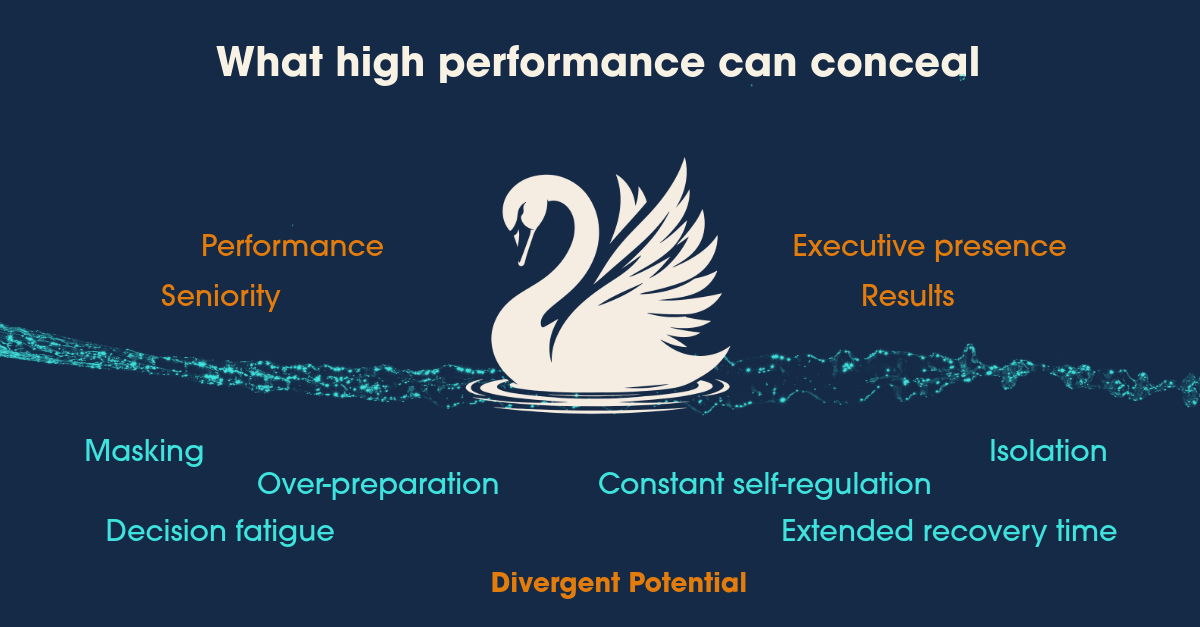
The career is working. The decisions are being made. The organisation is moving. From the outside — from the board, from the team, from the peers you’d run into at an industry event — everything looks like it’s working.
From the inside, something has shifted.
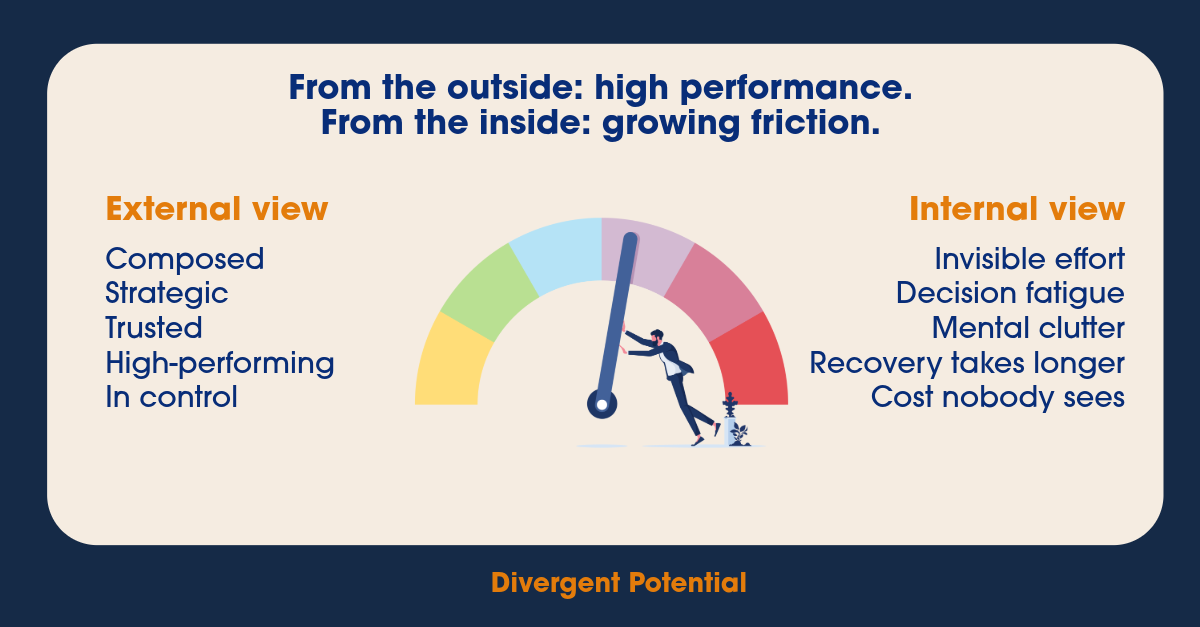
The workarounds and systems and sheer force of will that built this career are still in place. They’re just returning less than they used to. The mental preparation for a single difficult conversation used to be quick; now it takes longer. The recovery time after an intensive week has stretched. The kind of thinking you used to do easily — the big-picture strategic work, the genuine creative problem-solving — keeps getting crowded out by the operational weight of the role.
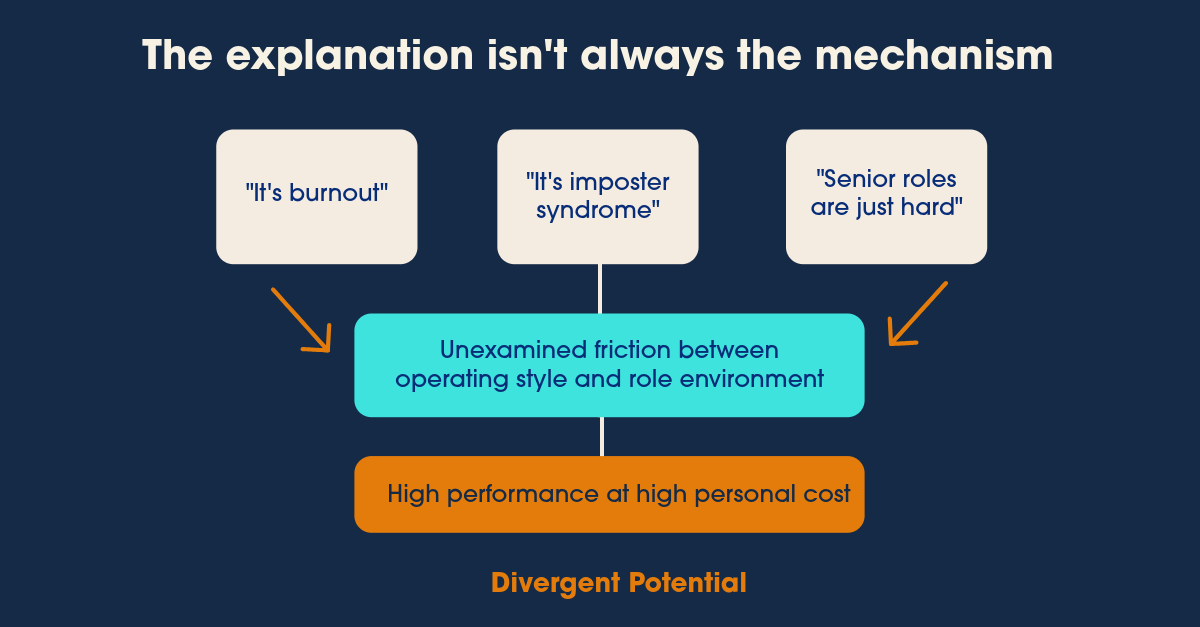
Most leaders who experience this reach for one of three explanations: burnout, imposter syndrome, or the simple fact that senior roles are demanding. These aren’t wrong. But they’re incomplete. They describe the symptom without identifying the mechanism producing it.
Research from DDI’s Global Leadership Forecast 2025 found that around 4 in 10 stressed leaders have considered leaving their roles entirely to protect their wellbeing — and the leaders most likely to follow through aren’t the ones visibly struggling. They’re the ones managing it quietly.
Why the Standard Explanations Don’t Quite Land
Burnout is real. If you’re experiencing it, it deserves to be taken seriously, not reframed away. But burnout as a concept tends to point toward depletion as the problem — which suggests that rest, recovery, and reducing load are the answer. For many senior leaders, that’s a partial solution at best. They take the break. They return. The same friction is waiting.
Imposter syndrome is similarly real and similarly partial. The experience of sustained high performance alongside a persistent sense that you’re about to be found out is genuinely common at senior level. But the standard response — you’ve earned your place, the evidence is there — doesn’t address why the feeling persists despite the evidence. It treats a structural experience as a cognitive distortion.
The third explanation — senior roles are just hard — is accurate but unhelpful. Of course they are. The question isn’t whether leadership at this level is demanding. It’s whether what you’re finding demanding is proportionate to what the role actually requires.
For some leaders, it isn’t. And the gap — between what leadership actually asks of them and what it’s costing them to deliver — has nothing to do with capability. It has to do with fit.
The Fit Problem Nobody’s Measuring
Most senior leadership environments were designed around a fairly consistent model of how a high-performing leader thinks, communicates, and makes decisions. The feedback systems, the performance frameworks, the definition of executive presence — all of it reflects that model. Which works well, for leaders who fit it.
For leaders whose natural operating style runs differently — who process information non-linearly, who communicate with a directness or intensity the environment misreads, who do their best thinking in ways that don’t map onto the standard rhythm of the senior role — the environment creates a specific and compounding friction. Not because they’re less capable. Because there’s a gap between how they work best and what the role consistently demands.
That gap doesn’t always produce visible problems. Often it produces the opposite: highly refined strategies for managing the gap, for navigating the environment, for delivering at a high level regardless. Strategies that work. That have always worked. That are, in fact, evidence of considerable capability.
But strategies have costs. And at senior level, where the ambient demands of the role are already high, the cost of running those strategies starts to accumulate in ways that the standard performance conversation has no framework for capturing.
71% of CEOs report experiencing burnout at least occasionally. 61% say that leadership isolation directly hinders their performance. The data isn’t pointing to a resilience problem. It’s pointing to a structural one.
Why High Performers Are the Last to Recognise This
There’s a particular irony in how this plays out. The leaders who are carrying the highest cost are often the ones least likely to name it — because the same qualities that generate the cost also generate the capability to absorb it without showing it.
The competence trap
If you’ve spent years developing effective strategies for navigating demanding environments, those strategies are deeply embedded. They’re automatic. They feel like you — like your work ethic, your standards, your professionalism. It takes deliberate examination to see them as strategies at all, let alone to ask whether they’re still the right ones at this level.
The seniority trap
At senior level, the social environment actively discourages honest self-report. Peers are also competitors. Direct reports need confidence. Boards need reassurance. The people who might previously have provided honest challenge have progressively fewer incentives to do so. The feedback loop that might have surfaced this earlier in a career has effectively closed.
The explanation trap
The standard narratives — burnout, pressure, the demands of the role — are available and plausible. They’re not wrong. They make it easy to account for what you’re experiencing without examining the underlying architecture that’s producing it. The explanation becomes a way of not looking further.
Senior leaders are twice as likely to report isolation compared to lower-level employees. The structural conditions that create that isolation also make honest developmental challenge almost impossible to access through normal channels.
What the Shift Actually Requires
The leaders who resolve this don’t do it by working harder, recovering better, or managing the symptoms more effectively. They do it by examining what’s actually producing the friction — with the precision and honesty that the senior environment structurally can’t provide.
That examination has a specific quality. It’s not therapeutic. It’s not remedial. It’s the kind of rigorous, direct, genuinely confidential thinking partnership that asks: what is actually happening here, beneath the level of the explanations you’ve already tried, and what would need to change for the work to feel proportionate to what it actually demands of you?
Most leadership development misses this. It works on behaviour — communication, decision-making, stakeholder management — without examining the architecture underneath. Which produces partial results: useful on the surface, incomplete underneath. A layer of the work that keeps getting approached and never properly landing.
The leaders who get the most from executive coaching at this level are rarely those in crisis. They’re the ones performing well who have recognised — often after years of managing it alone — that what they’re navigating deserves more than they can give it alone.
Understanding the friction precisely — not simply managing it — is where the real leadership development work begins.
The Question Worth Sitting With
If you recognise something in this, the useful question isn’t whether you’re managing. You clearly are. The question is whether the way you’re managing is the most efficient version of what’s possible — or whether there’s a version of this career that costs less and delivers more, and you’ve simply never had the right conditions to examine what that looks like.
Most senior leaders haven’t. Not because they lack the self-awareness, but because the environment consistently fails to provide what that examination requires: genuine honesty, real challenge, and the kind of thinking partnership that isn’t managed by the same social dynamics as every other relationship at this level.
The leaders who address this early perform better and sustain it longer. The ones who don’t tend to find that eventually, the decision gets made for them.
A note on what this work looks like
If you’re a senior leader who recognises this experience, the Executive Coaching for Professionals page describes the kind of engagement this piece is pointing toward. It’s not a support programme. It’s a rigorous thinking partnership designed for leaders who are performing well and ready to stop leaving the better version of that performance on the table.
If you’re an HR or L&D decision-maker reading this with someone specific in mind, the Coaching for Organisations page covers how this is structured at scale. The leaders described above are almost certainly in your senior cohort. They’re not flagging it.