
The Executive Presence Model Was Never Built for Every Kind of Leader
And the Most Effective Coaches Know It
The best executive coaching doesn’t develop you toward a model — it develops you toward your most effective self.
The board meeting went well. You read the room, held the line where it mattered, landed the recommendation. By any external measure, a good morning’s work.
So why, walking out, is there that familiar flicker of depletion — not from the decisions themselves, but from the performance of making them?
If you recognise that feeling, you’ve probably carried it for most of your career and never named it directly. The environment has never quite read you accurately. There’s always a slight adaptation running — to the room, to the expectation, to the unwritten rules about how a senior person is supposed to present. It hasn’t prevented success. It’s just made success cost more than it should. And it leaves a persistent, quiet sense that the version of you the organisation is responding to isn’t quite the real one.
This piece is about where that feeling comes from. What the executive presence model was actually built on, what it’s been measuring all these years — and why the friction says more about the framework than it does about you.
The leaders who have always felt slightly misread by the presence model aren’t imagining it. They’ve been navigating a framework built around a different kind of leader.
Where the Model Came From
Executive presence entered the leadership development vocabulary as a way of naming something real: senior roles demand more than technical capability, and how a leader shows up shapes how their judgement is received. That much is true, and it remains true.
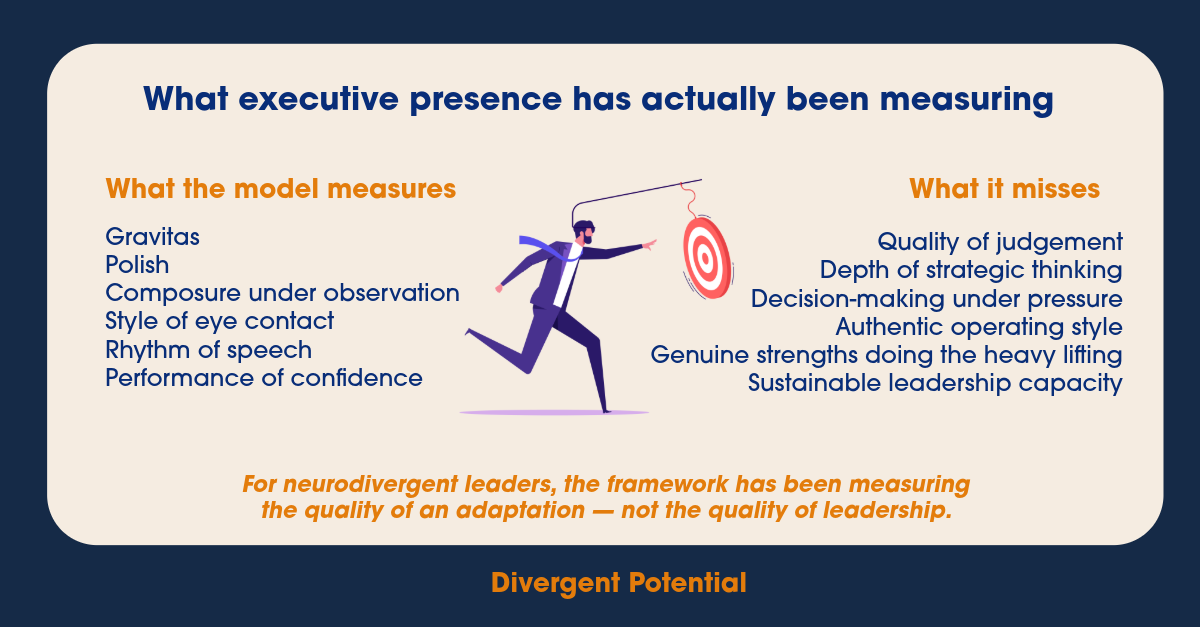
But the model that grew up around this observation was built by watching a particular kind of leader in a particular kind of environment. It codified gravitas, polish, composure under observation, a certain style of eye contact, a certain rhythm of speech, a certain performance of confidence — and then treated those markers as the substance of leadership rather than one culturally specific expression of it.
The result is a framework that measures conformity as much as capability. And most of the development industry built on top of it has never seriously asked who the template was modelled on — or who it quietly excludes.
What Executive Presence Has Actually Been Measuring
The evidence suggests that question matters more than the framework’s defenders tend to acknowledge.
Consider the environment in which presence gets assessed. Judgements about gravitas, credibility, and “how someone lands” are made by managers and boards operating with the same assumptions the model encodes — and the data on how well-equipped those assessors are is not encouraging.
The CIPD’s 2024 Neuroinclusion at Work report found that only around half of managers appreciate the value of neurodiversity — and fewer than half feel capable and confident supporting neurodivergent individuals at work.
Executive presence is assessed inside that environment. Which means, for a meaningful proportion of leaders, it has been measuring the quality of an adaptation — how convincingly a leader performs a style that was never natively theirs — rather than the quality of their leadership.
Now consider who has been succeeding anyway.
According to the World Economic Forum, up to 25% of chief executives believe themselves to be dyslexic — yet very few disclose it publicly.
Sit with that for a moment. A meaningful proportion of the people occupying the most senior role in organisational life are neurodivergent, and most have concluded that saying so is unwise. Which raises a serious question about what the presence framework has actually been measuring all these years — because it has plainly not been measuring the capacity to lead at the highest level. Neurodivergent leaders have been doing exactly that throughout. The framework simply hasn’t been able to see them accurately while they did it.
This connects to something I’ve written about before: the feedback reaching senior leaders gets thinner with seniority — and for some leaders, it was never quite accurate to begin with. When feedback has consistently measured presentation and conformity rather than impact, it doesn’t just feel incomplete. Over a career, it distorts a leader’s understanding of where their genuine strengths sit.
The Cost You’ve Been Absorbing
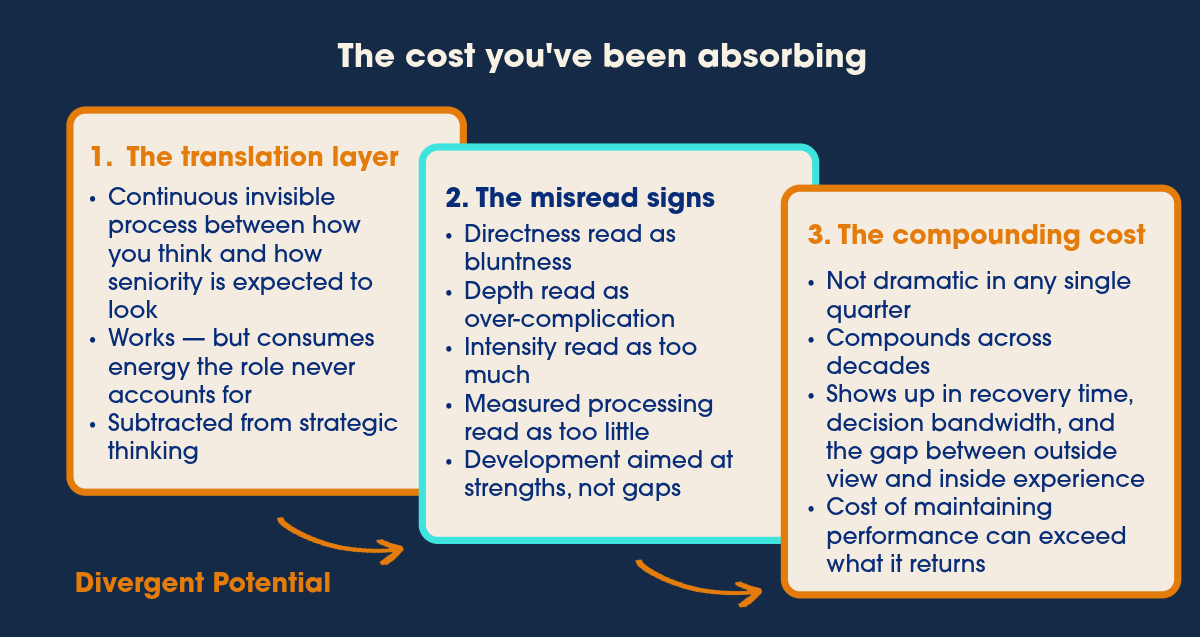
The leaders who’ve always felt slightly misread by this framework — many of them ADHD, autistic, dyslexic, or some combination, whether identified or not — have been succeeding in spite of it rather than because of it, and carrying the cost of that adaptation throughout their careers. That cost is real, it compounds, and it tends to show up in three recognisable patterns.
The translation layer
There’s a continuous, mostly invisible process running between how you naturally think and communicate and how the environment expects seniority to look. Every meeting, every board paper, every corridor conversation passes through it. It works — that’s the point. But it consumes energy the role never accounts for, and that energy is subtracted directly from the strategic thinking the role actually needs.
The misread strengths
Directness gets read as bluntness. Depth gets read as overcomplication. Intensity gets read as too much; measured processing gets read as too little. The qualities doing the heaviest lifting in your actual results are often the same ones the presence conversation keeps flagging for development — which means the development conversation has been pointed at your strengths, not your gaps.
The compounding cost
None of this is dramatic in any single quarter. That’s why it persists. But adaptation carried across decades compounds — in recovery time, in decision bandwidth, in the widening gap between how leadership looks from the outside and how it feels from the inside. By senior level, the cost of maintaining the performance can start to exceed what the performance returns.
The standard development conversation runs in one direction: here is the model, here is where you fall short, here is how we close the gap. The premise — that the model is the destination — goes unexamined.
And for a leader whose natural operating style was never within the template’s frame of reference, that premise quietly converts a design flaw in the framework into a development need in the person. That’s not development. That’s assimilation with a coaching invoice attached.
What the Most Effective Coaching Does Instead
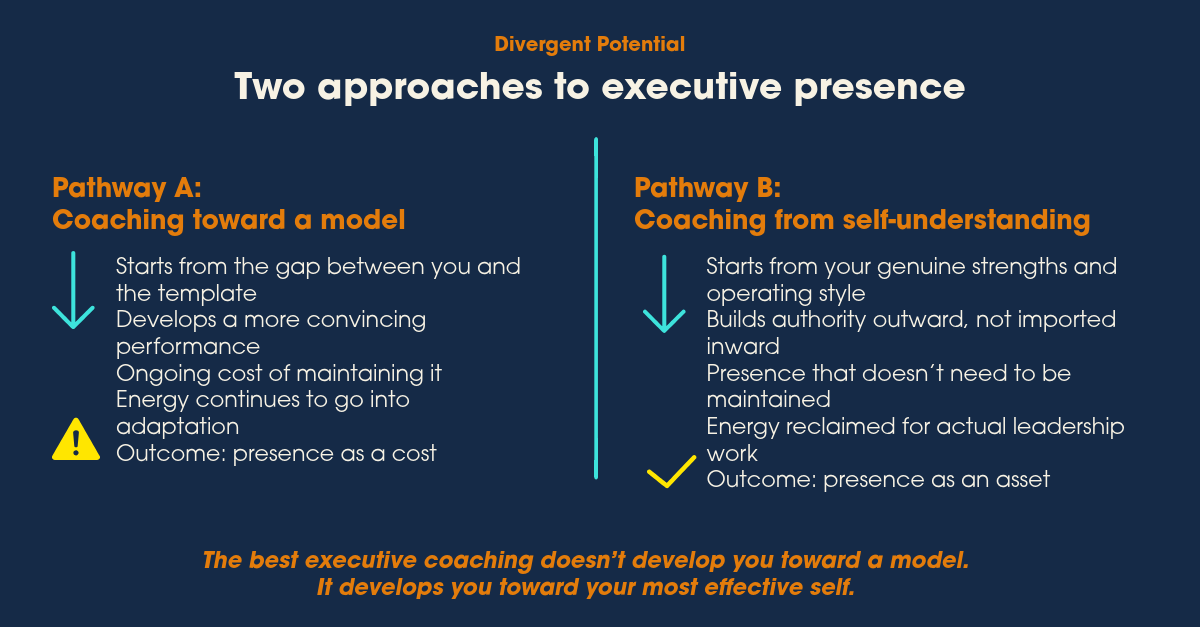
The best executive coaching doesn’t develop you toward a model. It develops you toward your most effective self.
In practice, that means the work starts from a different place entirely. Not from the gap between where you are and where the template says you should be — but from an accurate understanding of your genuine strengths, your authentic operating style, and the conditions under which your thinking and judgement are at their best. Leadership authority gets built from there, outward, rather than imported from a framework inward.
The distinction sounds subtle. The outcomes are not. Coaching that optimises a leader toward a template produces, at best, a more convincing performance — with all the ongoing cost that performance entails. Coaching that starts from accurate self-understanding produces something sturdier: presence that doesn’t have to be maintained, because it isn’t a construction. Authority that reads as credible because it is congruent. And a significant amount of reclaimed capacity — because the energy that was going into the translation layer becomes available for the actual work of leading.
None of this means abandoning the legitimate demands of senior roles. Influence, communication, and the ability to hold a room still matter. They simply get built on your actual foundations rather than borrowed ones — which is the territory of ethical, strategic influence, and it’s work I take seriously enough to have built a dedicated approach around.
Presence that has to be maintained is a cost. Presence that’s congruent is an asset. The difference between them is accurate self-understanding.
The Conversation This Usually Opens
For leaders who have always performed well but never quite felt accurately understood by the environments they’ve operated in, this is often one of the most significant conversations they have — and I say that having sat in it many times, on both sides.
Not because it changes what they’ve achieved. That stands — and if anything, it stands taller once they understand what it actually took. But because it reframes how they understand their own track record: no longer as success achieved despite some private deficiency, but as sustained high performance delivered while carrying a load the model never accounted for. From that more accurate foundation, the question of what to build next becomes genuinely open — and considerably more interesting.
For some leaders, that question leads deeper — into what it means to lead openly as a neurodivergent professional rather than around it.
What leadership authority becomes when it’s built on accurate self-understanding is not a hypothetical. It’s observable, it’s durable, and the leaders who get there tend not to look back.
A note on what this work looks like
If you’re a senior leader who recognises this experience, the Executive Coaching for Professionals page describes the kind of engagement this piece is pointing toward — a rigorous thinking partnership that starts from how you actually operate, not from a template you were never built to match.
If you’re an HR or L&D decision-maker, it’s worth asking what your presence and development frameworks are actually measuring in your senior cohort. The Coaching for Organisations page covers how this is structured at scale — because the leaders described above are almost certainly in your pipeline, being developed toward a model that’s costing you access to their best work.