
The Feedback Loop at the Top Is Broken
And It's Hitting Some Leaders Harder Than Others
At senior level the feedback gets thinner just as the decisions get bigger — and for some leaders it was never quite accurate to begin with.
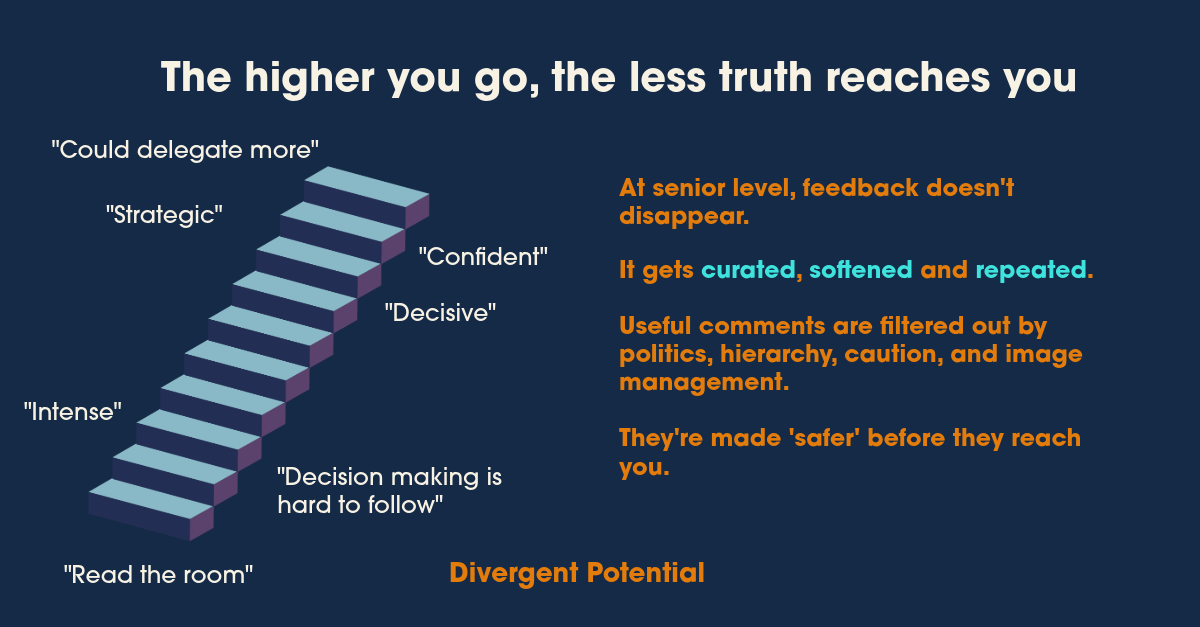
The 360 review lands in your inbox on a Friday afternoon. You already know roughly what it will say, because it says roughly the same thing every year. Strategic. Decisive. Could delegate more. Strong under pressure.
It's not wrong, exactly. It's just not telling you anything you didn't already know — and it hasn't for years.
That's not a coincidence, and it's not because you've stopped needing honest input. It's because the higher you go, the less of it reaches you.
The higher you go, the less anyone tells you the truth — and no dashboard on earth flags a feedback loop that's gone quiet.
Why the Loop Breaks at the Top
The mechanics are straightforward once you look at them directly. Peers become competitors, which makes candour a calculated risk rather than a reflex. Direct reports need managing, which makes upward honesty feel like a career decision rather than a comment. Boards need confidence, which means the version of you that reaches them is curated, on both sides, before either of you notices it happening.
The result is a growing gap between how you think you're leading and how it's actually landing — with no reliable mechanism to close it. Nobody sets out to build this. It's just what happens to feedback as it travels upward through an organisation that runs on hierarchy.
For Some Leaders, the Gap Was Never New
Here's the part that doesn't show up in most conversations about feedback at senior level.
A 2025 Harris Poll found that 77% of all adults agree neurodivergent employees face pressure to conform to neurotypical behaviours at work — rising to 82% among neurodivergent individuals themselves.
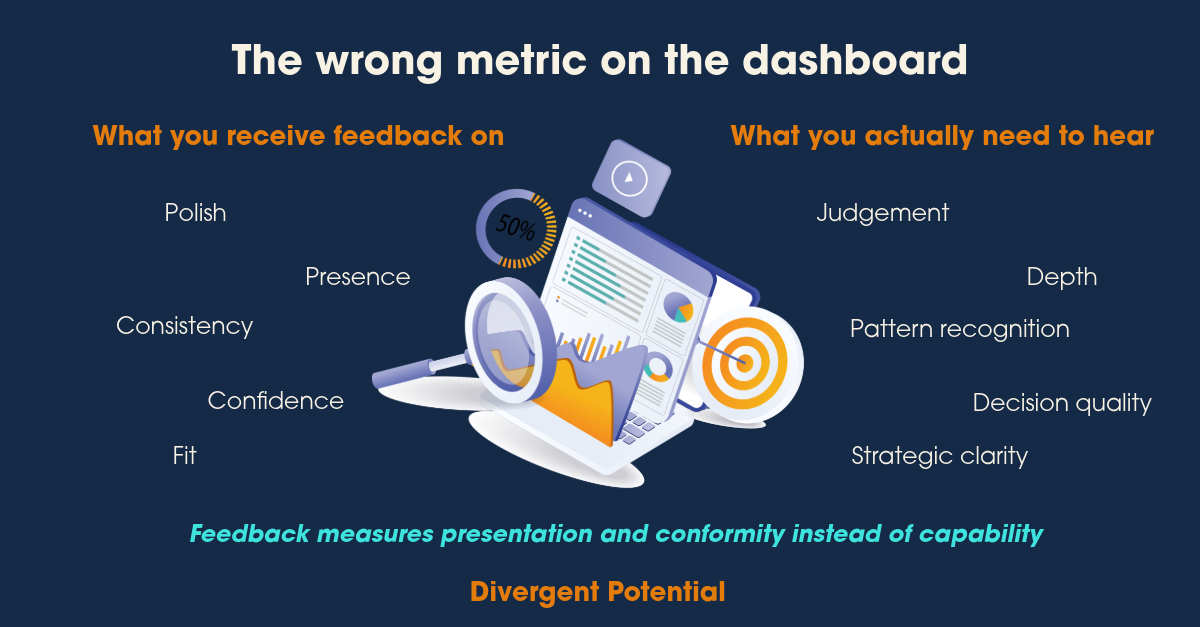
For a late-identified neurodivergent leader, the feedback gap described above isn't a new development that arrived with seniority. It's the same gap that's been running underneath their entire career — just harder to see, because for most of that career the feedback wasn't obviously wrong. It was measuring presentation and conformity, and calling it capability.
That doesn't just feel incomplete in the moment. Over an entire career, it actively distorts a leader's understanding of where their genuine strengths sit. You can spend twenty years being told to work on your presence and never once be told the truth: that the thing costing you energy was never a deficit, it was a translation tax.
The People Who Need It Most Get It Least
Senior leaders are already twice as likely to report isolation compared to lower-level employees.
The structural conditions that create that isolation are the same ones that cut off honest developmental feedback through the normal channels. Fewer peers who'll say the hard thing. Fewer environments where challenge doesn't carry political weight. Fewer people positioned closely enough to see the actual pattern rather than the polished version of it.
Which means the leaders most in need of an accurate outside perspective are, structurally, the ones least likely to receive it. Not because nobody cares. Because the environment that would normally supply it has quietly stopped functioning by the time someone reaches this level.
The leaders most in need of accurate external perspective are the ones least likely to receive it — and that's not a leadership failing, it's a structural one.
What Honest Feedback Actually Requires
This is where most attempts to fix the problem miss. More frequent reviews, better 360 tools, anonymous surveys — these add volume, not accuracy. They don't solve the underlying issue, which is that almost nobody around a senior leader has both the standing and the safety to say something genuinely unfiltered.
A well-structured executive coaching relationship is one of the only environments built specifically to do that — calibrated to how a leader actually thinks and leads, not to a generic template, and outside the political structure that makes candour costly everywhere else. That's not a luxury add-on to leadership development. At this level, it's closer to a performance necessity: the one reliable channel left for finding out how you're actually landing.
For leaders navigating this alongside a late diagnosis, the stakes are higher still — the identification itself doesn't tell you what to do with the career built on top of it, and accurate feedback is one of the few tools that can help sort what's genuinely yours from what was compensation.

The Question Worth Sitting With
What would change if the feedback you received finally measured the right things?
Not more feedback. Not kinder feedback. Feedback that's actually tracking impact and capability instead of presentation and conformity — the distinction that's been quietly missing from most of what's reached you for years.
This closes out my blog series on senior leadership, neurodivergence, and the specific costs that show up at the top and rarely get named directly — including why the leaders who see furthest often struggle to be heard, why executive presence measures conformity as much as capability, and why your highest performing leaders look fine right up until they leave.
A note on what this work looks like
If you're a senior leader who suspects the feedback reaching you has stopped being accurate, the Executive Coaching for Professionals page covers how a coaching relationship built for genuinely honest challenge is structured.
If you're responsible for senior talent and recognise this pattern across your leadership team, the Coaching for Organisations page covers what that looks like at scale.