
The Leader Who Sees Furthest Is Only an Asset If the Room Knows How to Listen
Developing That Capacity Is What Executive Coaching at This Level Is Actually For
The frustration isn't that the thinking is wrong. It's that the environment doesn't know how to receive it.
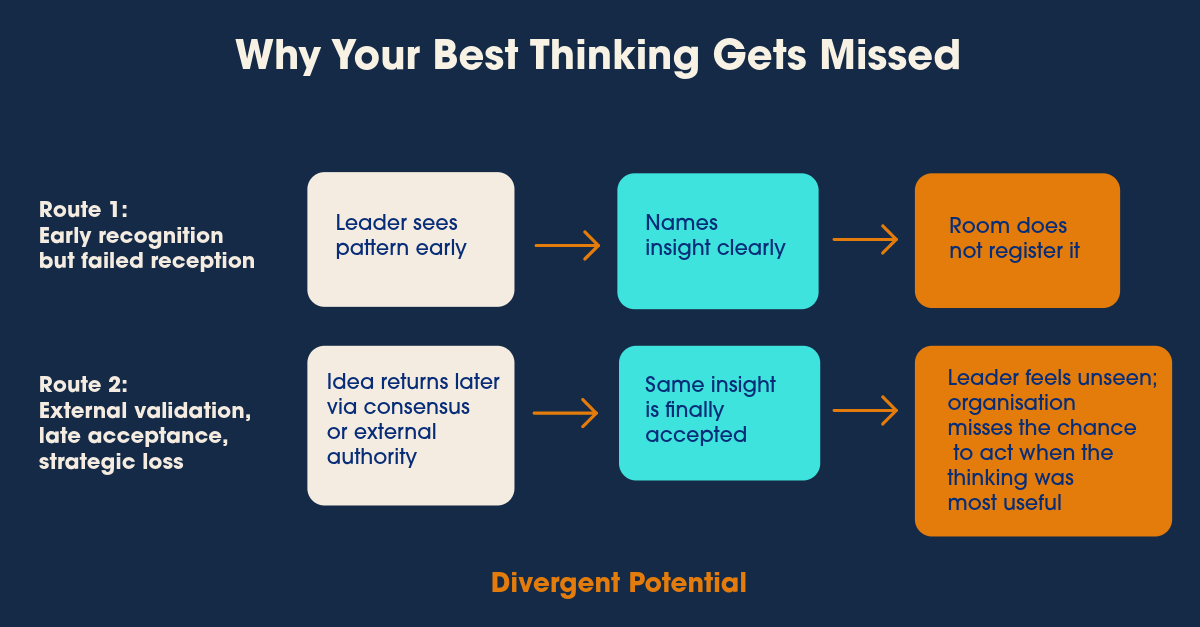
The meeting is forty minutes old when you say the thing.
Not dramatically. You've learned not to do that. Just clearly — the pattern that hasn't been named yet, the risk nobody's flagged, the strategic implication that everyone else in the room will arrive at eventually, once the moment to act on it cleanly has already passed.
The room nods. Moves on.
Eight months later, the same conclusion arrives by way of a consultant's slide deck, and everyone treats it as new. Nobody remembers you said it first, mostly because nobody registered it the first time.
This is a familiar pattern for late-identified neurodivergent leaders at senior level, and it sits at the centre of what executive coaching for neurodivergent leadership and strategic thinking is actually trying to solve. Not the thinking. What happens to it once it leaves your head.
The capabilities that make these leaders most valuable at senior level are simultaneously their greatest asset and the thing most consistently mismanaged by the organisations they work in.
Why This Isn't a Communication Problem
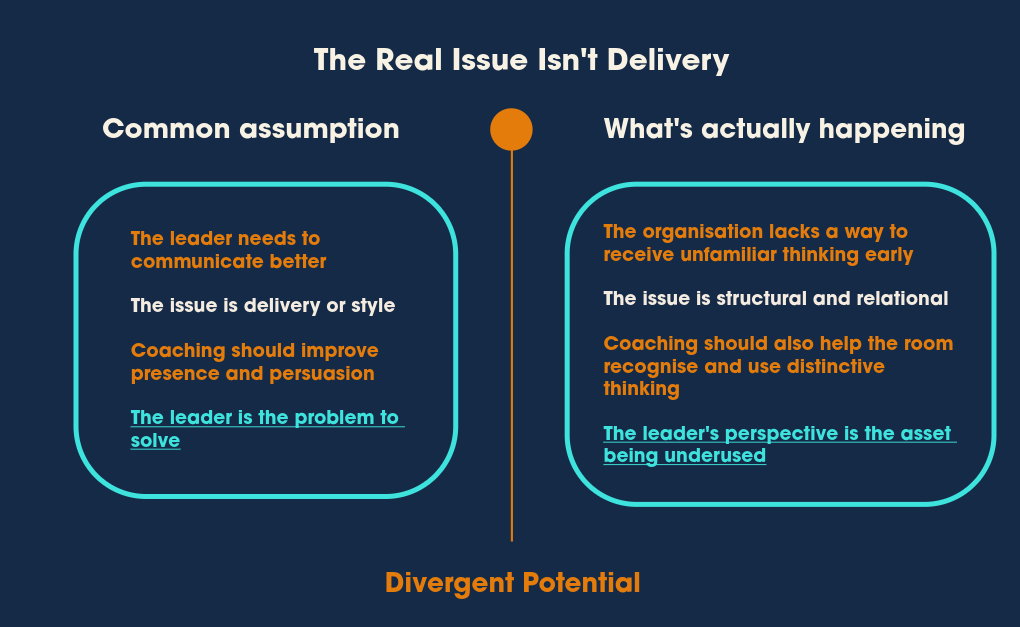
The instinct, when this pattern gets noticed at all, is to treat it as a delivery issue. Sharpen the stakeholder management. Work on the framing. Package the insight so it lands better next time.
Some of that is worth doing. None of it touches the actual mechanism, which is structural rather than stylistic. Most organisations don't have a reliable way of registering unfamiliar thinking until it's arrived at by consensus, on the room's own timetable. That isn't a flaw in how the insight was presented. It's a limit in how the room processes anything that shows up early.
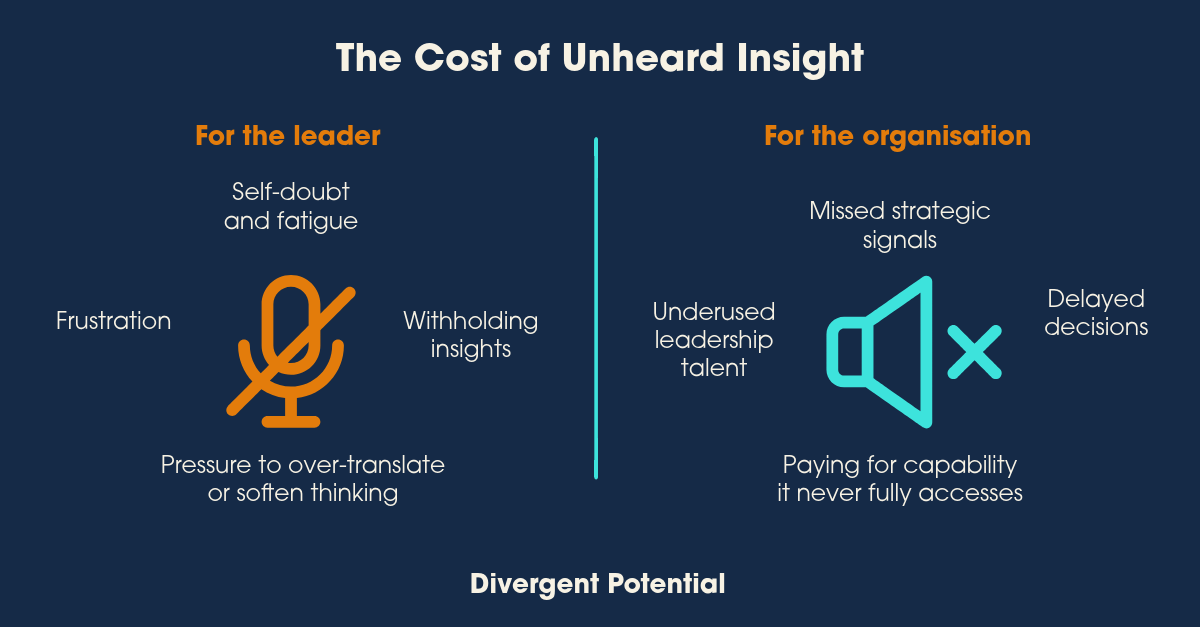
The cost lands in two places at once. You carry the frustration of watching good thinking go unused — and eventually the quiet fatigue of deciding whether it's worth saying again. The organisation carries something less visible but considerably more expensive: strategic decisions made without its best thinking actually in the room, even though the person who had it was sitting in it.
What the Data Says About Who's Paying for This
A 2024 industry study found that companies with genuinely neuroinclusive practices saw measurable returns from it — 63% reported improvements in overall employee wellbeing, 55% observed a stronger culture, and 53% reported better people management.
Separately, research from MetrixGlobal found that 77% of executives say coaching had a significant impact on at least one major business metric.
Put those two findings side by side and the case stops being a soft one. This isn't a diversity initiative wearing leadership language. It's a leadership effectiveness question — and the organisations seeing real returns from addressing it are the ones treating it as exactly that, not as something to be sensitive about, but as something to be competent at.
Developing the Room, Not Just the Leader
Most coaching stops at the leader's side of this. It works on confidence, on framing, on how to pitch an idea more persuasively — and leaves the room exactly as it was. That produces incremental improvement at best. The leader gets marginally better at translating. The organisation's capacity to receive unfamiliar thinking doesn't move at all.
For the leader
The more useful work is about getting sharper on when and how distinctive thinking actually lands — not diluting it, but understanding the mechanics of how it moves through a room and gets acted on. This is closely connected to something I've written about before: executive presence has always measured conformity as much as capability, and a leader who's learned to soften distinctive thinking to be better received has usually paid for that in more than one currency.
For the organisation
What's sometimes called strategic receivership — the deliberate capacity to register and use input that doesn't arrive in the expected shape, from the people positioned to see furthest — is a leadership capability like any other. It can be built. Most organisations have simply never been asked to build it.
Neither half works without the other. A leader who's brilliant at framing insight still loses if the room has no mechanism for hearing anything unfamiliar. A room that's genuinely open to different thinking still misses it if the leader has spent years learning to stop offering the version that would actually be useful.
A leader who's brilliant at framing insight still loses if the room has no mechanism for hearing anything unfamiliar.
What This Changes, Practically
For the leader, this is about operating with less friction and more actual impact — not by changing how you think, which was never the problem, but by developing how that thinking gets heard and used. That's a different coaching conversation to the one most senior leaders have had. It starts from the position that your perspective is the asset, not the thing standing between you and better presence.
For the organisation, it means finally getting proper access to a contribution it's been nominally employing but rarely fully hearing. That's not a rounding error. If you built a senior team partly for the range of thinking it brings, and you're structurally unable to receive half of what that thinking produces, you've paid for something you're not using.
The Conversation This Becomes
For leaders who've watched this pattern repeat for years — contributing genuinely, performing well, but rarely feeling their best thinking lands with the weight it deserves — this is usually one of the more significant conversations they have in a coaching relationship. Not because it changes what they've already achieved. That stands on its own. But because it reframes what happens next, and gives them something concrete to work with instead of a vague sense that they're not quite landing.
The organisations that learn to listen properly to this kind of leader end up with a genuine strategic advantage, not a diversity metric. And the leaders who find the right coaching relationship to work through this tend to describe it, afterwards, as the development conversation they'd been waiting years for.
A note on what this work looks like
If you're a senior leader who recognises this pattern, the Executive Coaching for Professionals page covers how this is structured — a rigorous thinking partnership focused on how your best thinking gets heard, not just how you're perceived.
If you're responsible for senior talent, the Coaching for Organisations page covers how this is built at scale — because the leaders described above are almost certainly already in your building.