
Why Your Highest Performing Leaders Look Fine, Right Up Until They Leave
The Retention Risk Your Frameworks Weren’t Designed to Detect
The leaders most at risk aren’t the ones asking for help — they’re the ones you’d never think to ask.
The resignation arrives on an ordinary Tuesday. A leader who has delivered reliably for years — absorbed complexity without complaint, held their numbers through every restructure, never once appeared on a risk register — hands in their notice, and means it.
The exit interview is polite and unilluminating. The counter-offer doesn’t land. And in the weeks that follow, the same sentence gets said in slightly different ways across the leadership team: we didn’t see it coming.
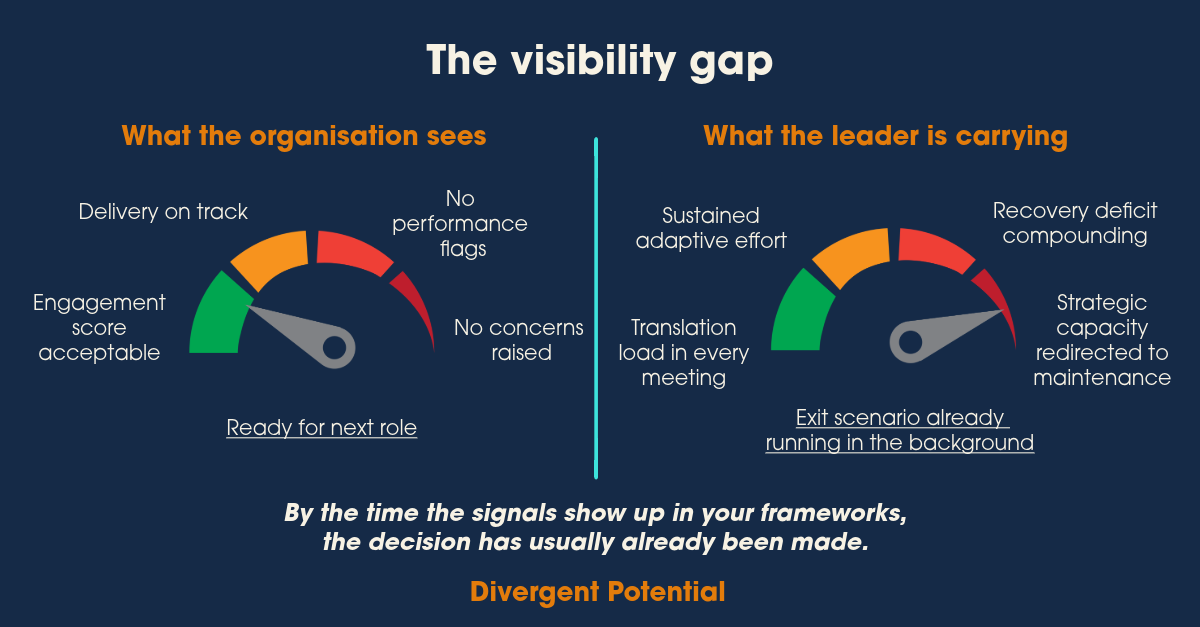
Except the signs were always there. They just weren’t visible through the frameworks being used to look.
This piece is about that pattern — why it keeps repeating, who it disproportionately affects, and what it costs to keep discovering it at the exit interview instead of before it.
The exit interviews are rarely illuminating. The signs, in retrospect, were always present — they just weren’t visible through the frameworks being used to look.
The Pattern You Only See in Retrospect
Senior attrition is not a marginal problem right now.
More than 43% of C-suite executives across 10 countries lost at least half their leadership teams last year, according to LHH research.
The conventional reading of numbers like that is market-driven: compensation, opportunity, restructuring fatigue. All real. But it misses the subset of departures that organisations feel most acutely — the high performers who leave without any of the usual warning signs, whose exits are the most expensive precisely because nobody priced them in.
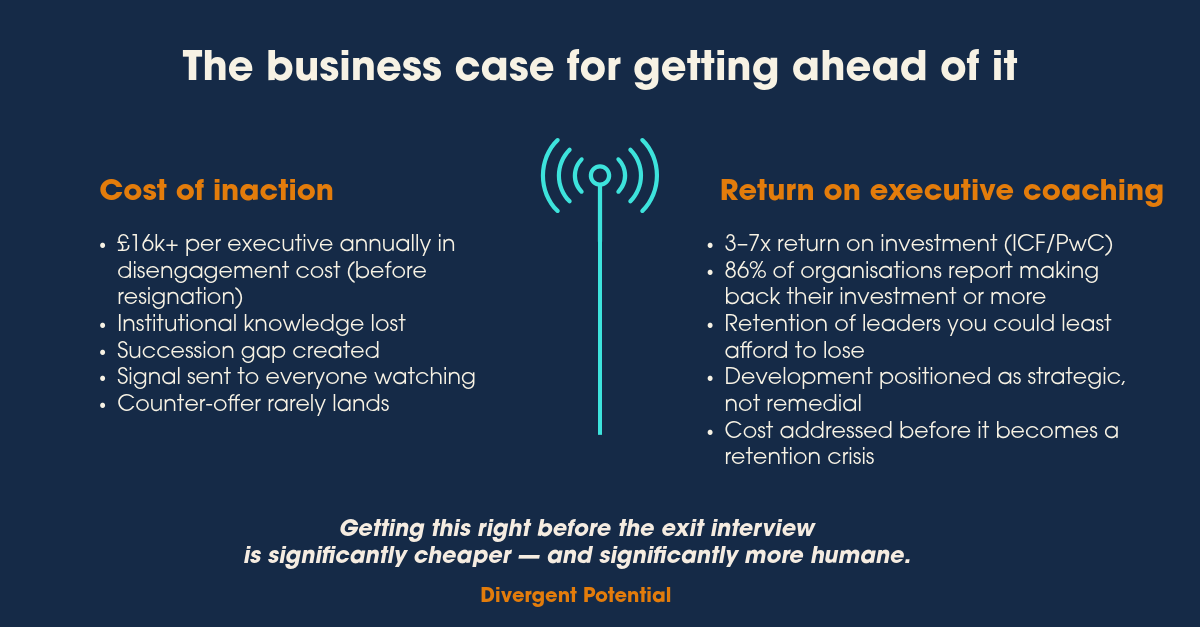
Burnout-related disengagement costs organisations an average of over £16,000 per executive annually — before a single resignation letter is written.
And that figure only captures the measurable drag. It doesn’t capture the strategic cost of losing someone who was never adequately understood — the institutional knowledge, the succession gap, the signal it sends to everyone watching how the organisation treats its most reliable people.
Why the Signals Don’t Show Up
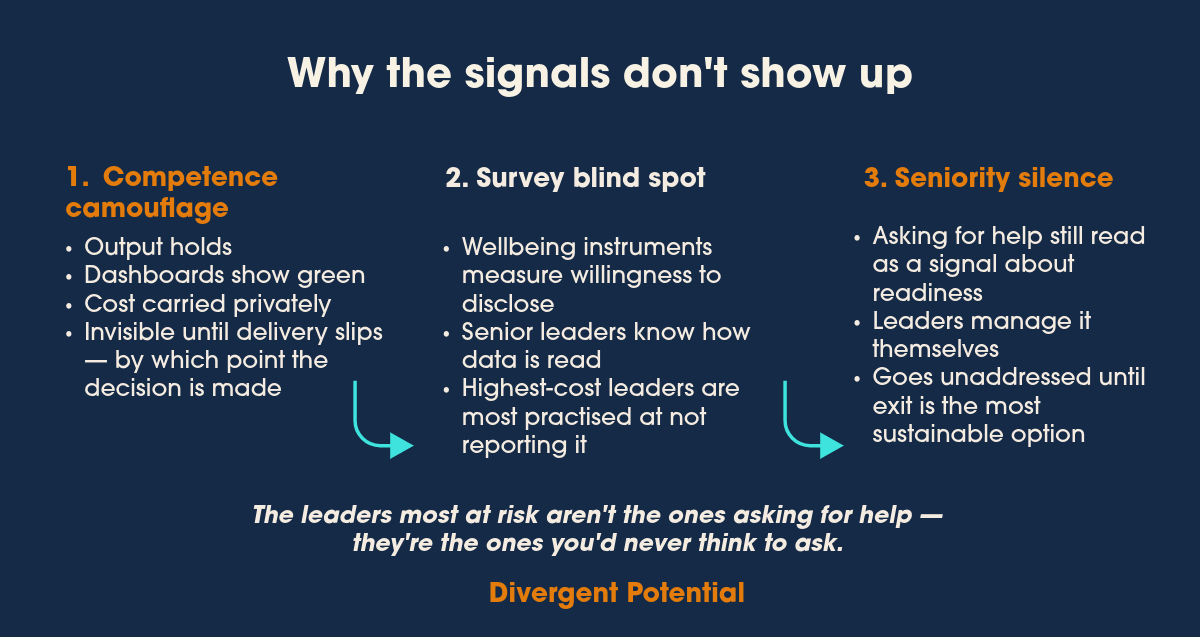
The leaders driving this pattern aren’t flagging concerns through wellbeing surveys or performance processes. That isn’t stoicism, and it isn’t an accident. It’s the predictable result of three dynamics operating together.
The competence camouflage
High performers absorb load by definition — it’s what made them high performers. Every dashboard your organisation runs measures output, and their output holds. So the cost gets carried privately, invisible to systems that were only ever designed to notice when delivery slips. By the time delivery slips, the decision has usually already been made.
The survey blind spot
Wellbeing instruments measure willingness to disclose, not actual load. A senior leader completing an engagement survey knows exactly how the data is read, who might see it, and what a low score could imply about their capacity for the next role. The people carrying the highest hidden cost are often the most practised at not reporting it.
The seniority silence
At senior level, asking for help is still widely — if quietly — read as a signal about readiness. So the leaders navigating the most friction do what has always worked: they manage it themselves. Which is precisely why it goes unaddressed until the cost becomes impossible to absorb, and the most sustainable option left on the table is the exit.
The question isn’t whether your senior leaders are coping. It’s whether the support infrastructure around them was designed for the full complexity of how they actually work.
Who’s Carrying the Hidden Cost
Here is the part of this pattern that most retention conversations never reach.
Late-identified neurodivergent leaders — ADHD, autistic, dyslexic, often some combination, frequently unidentified until well into senior careers — are disproportionately represented in exactly this profile. High-functioning. Highly capable. Sustaining performance through a level of adaptive effort their organisations have never seen, measured, or accounted for — and carrying a cost that only becomes visible when it stops being manageable.
Only 34% of neurodivergent employees report feeling well supported at work.
At senior level, that gap rarely surfaces as a complaint. Complaints are for people who believe the system has a category for what they’d be complaining about. It surfaces as a resignation — usually a composed, well-managed, entirely unexpected one.
I’ve written elsewhere about what sustaining that performance actually costs the individual — the hidden tax that compounds quietly at senior level. From the organisation’s side, the same dynamic reads differently: it’s capacity you’re paying for but not receiving, in a leader you’re at risk of losing without warning.
What Addressing It Actually Returns
The instinct at this point is often to reach for a wellbeing initiative. That instinct misreads the problem. The leaders described here don’t need resilience training — their resilience is, if anything, the thing masking the issue. What they need is support infrastructure designed for how they actually work: rigorous, confidential, and calibrated to the individual rather than the template.
That’s what properly structured executive coaching provides — and for this population specifically, coaching that understands the neurodivergent dimension isn’t a nice-to-have. It’s the difference between development that lands and development that adds another performance to maintain.
ICF/PwC research puts the return on executive coaching at 3 to 7 times the initial investment, with 86% of organisations reporting they made back their investment or more.
The organisations seeing those returns share one characteristic: they treat senior leader development as a strategic priority rather than a remedial one. They’re not waiting for the exit interview to understand what they had.
The Question Worth Asking Before the Exit Interview
The question worth asking isn’t whether your senior leaders are coping. On the evidence of every dashboard you run, they are — that’s the problem. The question is whether the support infrastructure around them was designed for the full complexity of how they actually work. For late-identified neurodivergent leaders at senior level, it almost certainly wasn’t.
Getting this right before it becomes a retention crisis is both significantly cheaper and significantly more humane than the alternative. And the leaders it retains tend to be exactly the ones you could least afford to lose.
A note on what this work looks like
If you’re responsible for senior talent, the Coaching for Organisations page covers how this is structured — confidential, individually calibrated executive coaching for the leaders carrying the pattern described above, positioned as leadership development rather than intervention, because that’s what it is.
And if you’re reading this recognising yourself rather than your organisation — that happens more often with this piece than you might expect — the Executive Coaching for Professionals page is the better starting point.